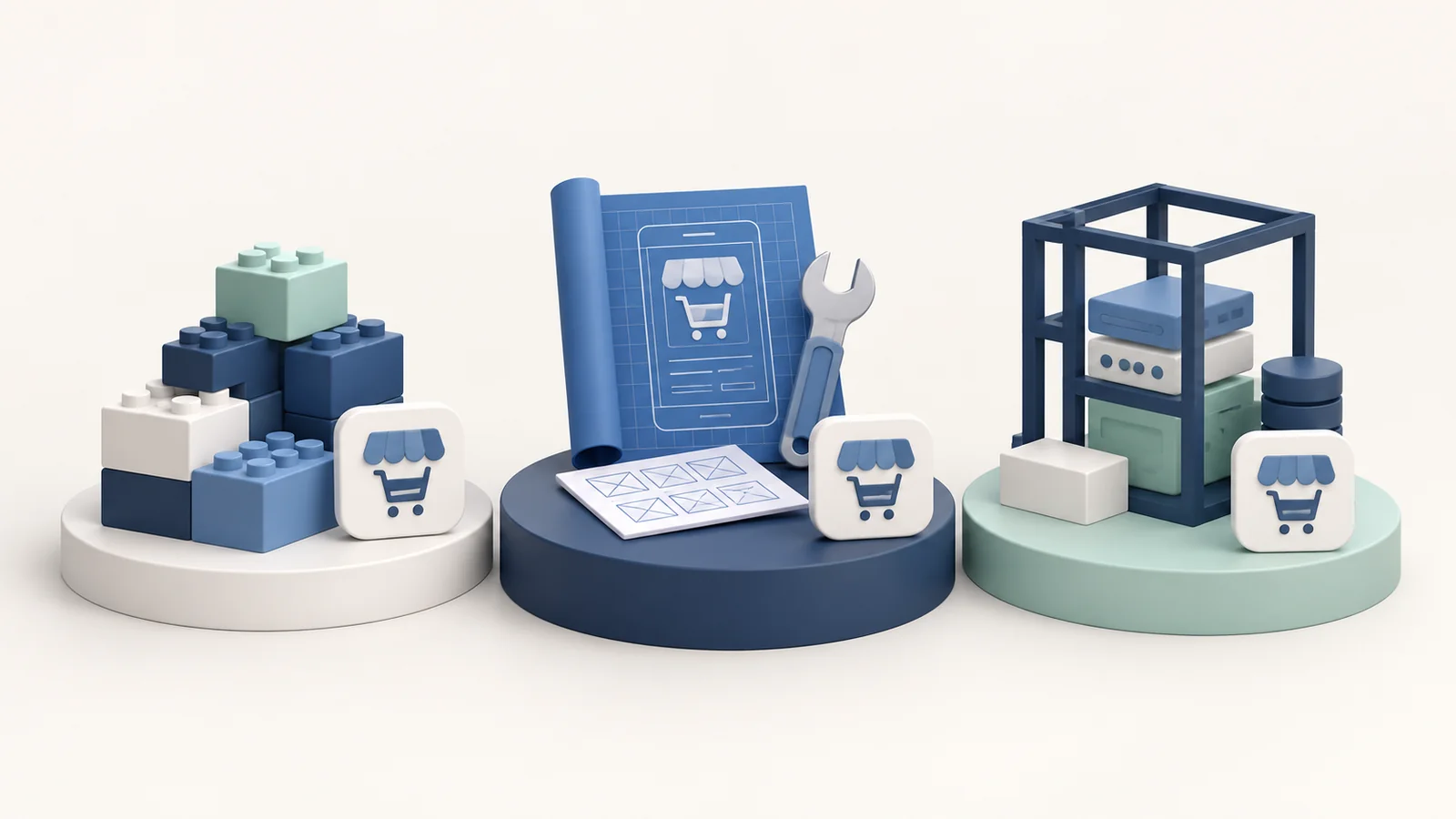
An app builder, an agency, and an in-house team aren’t three versions of the same purchase.
An app builder is a product platform. An agency is a service model. An in-house team is an ownership and staffing model. An agency may configure an app builder or develop a custom app, while an in-house team may also use a builder rather than create everything from scratch.
That distinction matters because the cost follows the underlying technology and the work your organization retains.
For many ecommerce brands, a mobile app builder is the lowest-cost and fastest route to a capable customer app. An agency can reduce internal workload and support a more tailored experience. An in-house team offers the most direct control, but only makes economic sense when the product is strategic enough to keep a permanent team busy.
How Builders, Agencies, and In-House Teams Compare
| Factor | App builder | Agency | In-house team |
|---|---|---|---|
| Initial cash cost | Low to medium | Medium to high | High |
| Ongoing cost | Subscription plus internal operations | Retainer, project fees, software, and internal oversight | Salaries, tools, infrastructure, and contractors |
| Launch speed | Usually fastest | Medium | Usually slowest from a cold start |
| Customization | Limited to platform and extensions | Medium to very high | Very high |
| Internal technical burden | Low to medium | Medium | High |
| Direct control | Medium | Medium | High |
| Maintenance ownership | Mostly vendor, with shared brand responsibility | Agency, platform, and brand | Brand |
| Switching cost | Medium to high | Medium to high | High, but code and knowledge may be owned internally |
| Best fit | Proven commerce journeys and faster time to value | Brands needing delivery capacity or tailored work | Strategic product with sustained roadmap and technical scale |
The cheapest quote isn’t always the cheapest operating model. Compare all options over at least three years.
What Each Option Includes
Start by separating the technology from the people delivering and operating it.
Ecommerce App Builder
An app builder provides the underlying app technology, management interface, commerce integration, release system, and a set of reusable components.
Some products are self-service. Others include design, implementation, submission, strategy, or ongoing managed services.
The model reduces the amount of custom software your brand has to create and maintain. The tradeoff is that the product must stay within the platform’s architecture, supported integrations, extension model, and release process.
Agency
An agency supplies people and delivery capability. It may configure a third-party app builder, create a custom or cross-platform app, design the customer experience, build integrations, and manage testing and releases. The scope varies considerably, which is why the technology underneath the proposal matters as much as the agency label.
Ask what technology sits under the proposal. “Agency-built” doesn’t necessarily mean custom, and custom development doesn’t necessarily mean the agency owns every layer.
In-House Team
An in-house model puts product, design, engineering, quality assurance, data, and release knowledge inside the organization.
The team can build a custom app, use a cross-platform framework, or operate an app builder. The defining feature is that the brand employs the core people responsible for the product.
This creates control and institutional knowledge, but the cost continues whether the roadmap is full or quiet. Those differences become easier to compare once you translate each model into the same cost categories.
Typical Cost Structure
Exact prices change by vendor, market, scope, and seniority. Use the ranges below as planning categories rather than quotes.
App Builder Costs
The main costs are setup, monthly or annual platform fees, paid integrations, custom extensions, developer accounts, and app promotion. Some vendors also charge according to revenue, usage, markets, features, or support tier.
The subscription still isn’t the whole cost. Your team will usually retain merchandising, lifecycle, creative, analytics, and QA work, even when the vendor maintains the mobile app technology.
Self-service ecommerce app builders often begin in the low hundreds of dollars per month. More capable or managed platforms can run from roughly $1,000 to several thousand dollars per month, with enterprise contracts above that range.
The low entry price is useful, but confirm what is required to publish and operate a production app. A plan that only supports previewing isn’t a launch cost.
Agency Costs
Agency pricing may combine discovery, product strategy, UX and visual design, software licenses, custom development, integrations, project management, QA, store submission, and ongoing support. Ask for those elements separately so you can see what is a one-time delivery cost and what continues after launch.
A builder implementation can cost far less than a custom app even when both are delivered by an agency. A custom ecommerce app commonly reaches tens or hundreds of thousands of dollars because the team is designing, engineering, integrating, testing, and releasing a unique software product.
Ask for the platform and third-party costs separately from agency fees. Otherwise, a low build quote may hide a recurring software commitment.
In-House Team Costs
Salary is only the start. A durable in-house mobile app development capability may need product management, product design, mobile or cross-platform engineering, backend integration work, quality assurance, analytics, DevOps, security, and release support. Some roles can be shared with the wider ecommerce team, but their time still belongs in the model.
The fully loaded cost includes salary, benefits, payroll costs, recruitment, management, equipment, software, cloud infrastructure, training, leave, and staff turnover.
If you already employ these people, allocate their time. The work still displaces another roadmap item. With those costs identified, you can put all three options into one model.
A Three-Year Cost Model
Use the same structure for all three options:
Three-year TCO =
initial delivery
+ 36 months of software and services
+ internal labor
+ integrations and infrastructure
+ maintenance and releases
+ adoption and marketing
+ expected change requests
+ switching or exit provision
To make the model concrete, assume a mid-market retailer needs catalog browsing, customer accounts, loyalty, subscriptions, push notifications, checkout, analytics, and two moderate integrations. All three options are expected to support the same customer journeys over three years.
For the builder option, assume a $20,000 implementation, a $2,000 monthly platform cost, 35 internal hours per month at a loaded rate of $70, and $30,000 for extensions and change. For the agency option, assume a $150,000 custom build, $2,500 per month for infrastructure and software, 50 internal oversight hours per month at $70, and $150,000 of maintenance and change work.
The in-house option assumes $100,000 for recruitment and initial technical setup, $120,000 of infrastructure and tooling across three years, and a lean cross-functional team allocation costing $400,000 per year. That team figure isn’t a universal salary benchmark; it’s an input the retailer would replace with its own loaded staffing cost.
| Cost category | Builder | Agency-led custom | In-house custom |
|---|---|---|---|
| Initial delivery or team setup | $20,000 | $150,000 | $100,000 |
| Software and infrastructure, 3 years | $72,000 | $90,000 | $120,000 |
| Internal labor or dedicated team, 3 years | $88,200 | $126,000 | $1,200,000 |
| Maintenance and change | $30,000 | $150,000 | Included in team cost |
| Launch and adoption | $45,000 | $45,000 | $45,000 |
| Three-year total | $255,200 | $561,000 | $1,465,000 |
These figures are a worked scenario, not market averages. They show how the cost categories behave and, more importantly, where each model concentrates the spend.
The builder is cheaper because the platform spreads product and maintenance costs across many customers. The agency model pays for tailored delivery and external capacity. The in-house model pays for persistent capability and control.
Change the assumptions to match your scope, rates, team, and existing systems. The model gives you a starting point, but the workload behind each number decides whether the comparison is fair.
Compare the Work, Not Just the Technology
Every option leaves work with the brand.
Even a fully managed service needs decisions, approvals, product data, campaign inputs, customer support, legal review, and measurement. An agency can execute the work but can’t own the commercial outcome on your behalf.
Build a responsibility matrix for:
| Responsibility | Questions to settle |
|---|---|
| Product roadmap | Who prioritizes features and accepts tradeoffs? |
| Merchandising | Who keeps the app current with campaigns and inventory? |
| Lifecycle | Who plans, builds, and measures push messages? |
| Integration | Who fixes failures across the ecommerce stack? |
| Releases | Who tests, submits, monitors, and rolls back? |
| Analytics | Who defines metrics and reconciles orders? |
| Support | Who responds to reviews and customer issues? |
| Compliance | Who owns privacy, accessibility, security, and store policy? |
Price the responsibilities that remain internal. A service isn’t cheaper if it creates a large coordination load your team can’t absorb.
When an App Builder Is the Best Value
Choose a builder when your required journeys fit the platform, speed matters, and you don’t want to own the full software stack.
The model is strongest when:
- Your ecommerce platform and important tools have proven integrations.
- Most requirements are established commerce patterns.
- The app can use reusable components without weakening the brand.
- Internal technical capacity is limited.
- The expected app value doesn’t justify a custom team.
Check customization limits, data access, developer account ownership, pricing changes, extension options, and exit terms before committing. If those limits rule out a builder, the next question is whether an agency adds enough value to justify the premium.
When an Agency Is Worth the Premium
An agency can be the right choice when the brand needs experienced delivery capacity, a tailored customer experience, complex integration work, or help operating the app after launch.
The premium is easier to justify when the agency has relevant commerce expertise and can show who will do the work. Ask to meet the product, design, engineering, and QA leads rather than evaluating only the sales team.
Clarify whether the agency is accountable for outcomes, deliverables, or staff capacity. These are different commercial models. When the work is continuous and strategically important, bringing that capability in-house can become the stronger option.
When an In-House Team Makes Sense
Build an internal team when the app is a strategic product with a sustained roadmap, unique customer capabilities, complex proprietary systems, and enough economic value to justify permanent expertise.
Control alone isn’t enough. The organization also needs product leadership, engineering management, release discipline, security, QA, and the ability to recruit and retain mobile specialists.
If the roadmap is mostly standard catalog, account, loyalty, push, and checkout functionality, an internal custom build may spend heavily to recreate capabilities a platform already maintains. In practice, this is why many brands combine the three models rather than choosing a pure version of one.
Hybrid Models Are Common
You don’t have to choose one pure model.
A brand might use an app builder, hire an agency for implementation and design, and keep product ownership in-house. Another might maintain an internal product team while outsourcing specialist development. A third may launch on a builder, validate demand, and invest in custom capabilities later.
The right hybrid puts strategic decisions and customer knowledge close to the brand while sourcing commodity technology and variable capacity efficiently.
Questions to Ask Before Comparing Quotes
- Is the proposed app built on a platform, custom code, or both?
- What work is included at launch, and what becomes a change request?
- Which recurring software, integration, support, and usage fees sit outside the quote?
- How much internal time will the model require each month?
- Who owns the developer accounts, data, designs, code, and custom integrations?
- What happens when the contract ends or a key employee leaves?
Put every answer into the same total cost of ownership model.
Bottom Line
An ecommerce mobile app builder is usually the most economical route when your needs fit the product. An agency costs more but can add delivery capacity, expertise, and customization. An in-house team offers the most direct control and the highest fixed commitment.
The choice doesn’t have to be pure. Many brands keep product ownership in-house, use a builder for the underlying technology, and bring in an agency for implementation or specialist work.
Start by defining the customer journeys and responsibilities the app needs. Then price the same scope, internal workload, and three-year operating period across every option. That gives you a useful comparison instead of three quotes for three different things.