For a long time, mobile apps were mostly reserved for the biggest ecommerce brands.
Launching one meant hiring developers, building separate versions for iOS and Android, and taking on a significant long-term software project.
That’s no longer the case.
Ecommerce mobile app builders have made it possible for any established online store to launch an app without the time, cost and technical complexity of custom development.
But that doesn’t mean every ecommerce store needs one.
A mobile app is a valuable retention and revenue channel. It gives customers a faster way to shop, makes it easier to encourage repeat purchases, and gives the brand a direct communication channel through push notifications.
But an app still needs an audience, a clear purpose and a plan for getting customers to download it.
Some brands don’t have the audience to justify an app yet. Some don’t have the business model to make it worthwhile.
In this guide, we’ll break it all down for you, looking at the case for launching an ecommerce app, the signs that your brand should have an app, the signs it might not be the right move (at least, not the right move yet), and a simple readiness test to help you understand if the time is right for you to launch your own mobile app.
The Case for an Ecommerce Mobile App
A mobile app can be a powerful brand asset.
It gives your most valuable customers a faster, more convenient and more direct way to interact with your brand. And it gives you a direct line to those customers.
That can create several important advantages.
A Better Experience for Mobile Shoppers
Most ecommerce traffic now comes through mobile devices.
But shopping through a mobile browser is not always the ideal experience.
Customers may need to reopen the browser, find the site again, sign back into their account and navigate through the store every time they want to make a purchase.
An app reduces some of that friction.
The brand has a permanent place on the customer’s home screen. Customers can open it with one tap, stay logged in, access their account and return to products more easily.
Depending on the app, it may also offer:
- Faster navigation
- Persistent login
- Saved preferences
- Easier access to loyalty rewards
- Smoother repeat purchasing
- App-specific content and offers
- Faster access to customer accounts and order information
These differences may seem small individually. But for a loyal customer who shops regularly, they can make the brand noticeably easier to buy from.
A Direct Channel Through Push Notifications
Push notifications are one of the strongest arguments for launching an ecommerce app.
They allow brands to send messages directly to the lock screen of a customer’s phone.
A customer doesn’t need to open an inbox, search for an email, or notice a social post. The message appears immediately, and a single tap can take them directly to a product, collection, offer or cart inside the app.
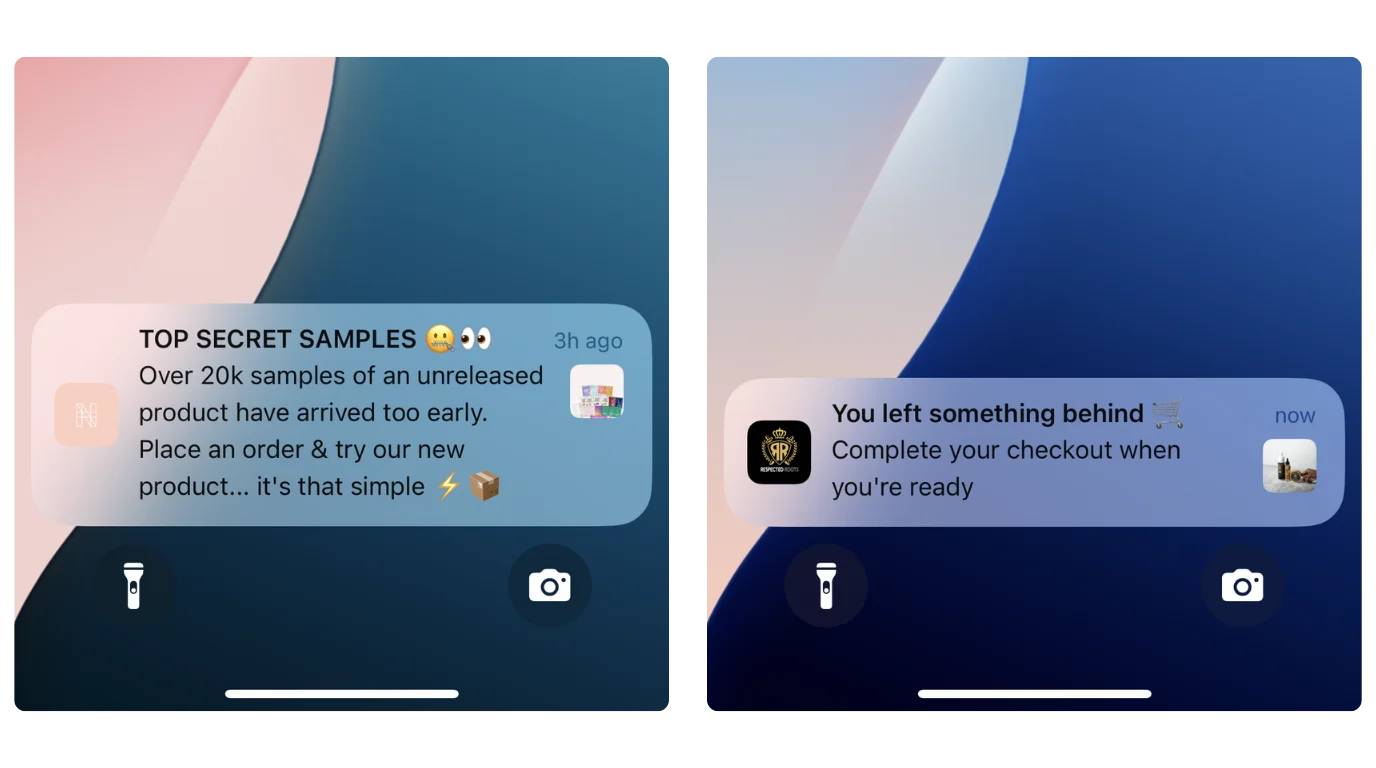
Push can be used for:
- Product launches
- Sales and promotions
- Abandoned carts
- Back-in-stock alerts
- Price-drop notifications
- Loyalty updates
- New collections
- Limited releases
- Personalized recommendations
Unlike SMS, there is generally no cost attached to each individual message.
Push also gives brands another way to reach customers when email engagement is declining, SMS is becoming expensive, or paid retargeting is delivering weaker returns.
That doesn’t mean push should replace those channels.
It gives the brand another direct line to its most engaged customers.
More Opportunities to Drive Repeat Purchases
Mobile apps tend to work best as a retention channel.
They are not usually designed to convince someone who has never heard of the brand to make their first purchase. They are more valuable for customers who already know the brand and have a reason to come back.
The app gives those customers a quicker route back into the store.
This can be especially valuable for businesses that naturally generate repeat purchases, such as:
- Fashion and apparel
- Beauty and skincare
- Supplements
- Grocery
- Food and drink
- Pet products
- Baby products
- Hobby and enthusiast products
- Collectibles
- Subscription products
The more regularly customers shop, the more useful it becomes to have the brand installed on their phone.
A Channel for Your Best Customers
Most people will not download an app for a brand they have no real connection with.
The customers who do install it are more likely to be existing buyers, loyal followers and people with a stronger interest in the brand.
That makes the app audience particularly valuable.
You are not necessarily reaching the largest possible audience. You are creating a channel for the people most likely to buy again.
The app can then give those customers:
- Early access to launches
- App-only promotions
- Loyalty benefits
- Exclusive content
- Faster reordering
- Personalized alerts
- Member-only experiences
This gives customers a reason to keep the app installed, while giving the brand more ways to build long-term value from its strongest customer relationships.
Less Dependence on Paid and Rented Channels
Most ecommerce brands rely heavily on channels they do not fully control.
Paid acquisition depends on ad costs and platform performance. Organic social reach depends on algorithms. Email depends on deliverability and the customer noticing the message. SMS can become expensive at scale.
A mobile app does not remove the need for these channels.
But it gives the brand another owned destination and another way to communicate directly with customers.
Once someone has downloaded the app and opted into notifications, the brand can reach them without paying for every impression or click.
That makes the app particularly useful for ecommerce brands trying to improve retention and get more value from the customers they have already paid to acquire.
Signs Your Ecommerce Brand Should Have an App
There is no single metric that tells you whether your brand is ready for an app.
It is more useful to look for a combination of signals.
You do not need to meet every condition below. But the more that apply, the stronger the case becomes.
Most of Your Traffic Comes From Mobile
An app makes the most sense when customers are already shopping through their phones.
If mobile accounts for the majority of your website traffic and a meaningful share of sales, improving the mobile experience can have a significant impact.
You already know that your audience is comfortable discovering, browsing and buying on mobile.
The app gives your best mobile customers a more direct and convenient version of an existing behavior.
On the other hand, if very little of your traffic comes from mobile, there may be limited demand for a dedicated mobile experience.
You Have a Significant Base of Existing Customers
An app needs an audience.
The easiest people to convince to download it are usually customers who already know and trust the brand.
A business with a large customer list has more people it can promote the app to through:
- SMS
- Website banners
- Order confirmation pages
- Packaging
- Social media
- Loyalty programs
- Physical stores
A new store with only a small number of customers may struggle to generate enough downloads to make the app worthwhile.
An established brand has a much stronger starting point.
Customers Buy More Than Once
Repeat purchase behavior is one of the clearest signals that an app could work.
Customers are unlikely to keep an app installed if they only expect to buy from the brand once.
But when people naturally return every few weeks or months, the app has an ongoing purpose.
It can make the next purchase easier, remind the customer when it is time to reorder, and give them a faster way to see what is new.
The more frequently customers purchase, the stronger the potential value of the app.
You Regularly Launch Products or Run Promotions
Apps work well for brands that have regular reasons to bring customers back.
This could include:
- New product drops
- Seasonal collections
- Limited releases
- Restocks
- Flash sales
- Member events
- Weekly promotions
- New content
Push notifications give the brand an immediate way to announce these moments.
A product drop can be sent directly to a customer’s lock screen, with a deep link taking them to the exact product or collection inside the app.
That is particularly useful for brands where timing matters, such as limited stock, fast-moving launches or time-sensitive offers.
You Have a Strong Loyalty, Membership or Subscription Program
An app becomes more useful when customers have something ongoing to manage or engage with.
For example, the app can give customers a central place to:
- Check loyalty points
- Redeem rewards
- Access membership benefits
- Manage subscriptions
- View exclusive products
- Receive personalized offers
- Get early access to launches
This gives the customer a reason to open the app even when they are not immediately making a purchase.
The app becomes part of the wider customer relationship, rather than simply another checkout channel.
Your Mobile Website Gets Traffic but Converts Poorly
A large gap between mobile traffic and mobile conversion may suggest an opportunity.
Mobile shoppers often face more distractions, less screen space and more checkout friction than desktop customers.
An app may create a smoother experience for returning users through persistent login, faster access and more streamlined navigation.
However, an app should not be used to avoid fixing basic website problems.
If the mobile site is slow, confusing or poorly merchandised, those issues should be addressed first.
The app is most useful when the underlying store is already strong, but the brand wants to create an even better experience for its most valuable mobile shoppers.
Email and SMS Are Becoming Harder to Rely On
Many ecommerce brands have built their retention strategy around email and SMS.
Both remain important channels, but they come with limitations.
Customers have crowded inboxes. Deliverability can be inconsistent. SMS can become expensive. And sending more messages does not necessarily mean customers will pay more attention.
Push gives the brand another option.
It can be used alongside email and SMS, with each channel playing a different role.
For example, email may be better for long-form content, while push is better for urgent, immediate or highly targeted messages.
A brand with a large customer base and rising communication costs may find that an app adds useful reach without requiring it to pay every time it contacts a customer.
Customers Are Already Asking for an App
Sometimes the clearest evidence comes directly from the customer.
Look for requests in:
- Surveys
- Support tickets
- Product reviews
- Social comments
- Community groups
- Loyalty member feedback
- Conversations with repeat buyers
Customers may ask for easier reordering, quicker access to loyalty rewards, better mobile navigation or a dedicated place to manage their account.
They may not always ask for “an app” specifically.
But repeated requests for a more convenient mobile experience can still indicate demand.
You Have a Realistic Plan to Drive Downloads
An app will not grow simply because it appears in the app stores.
You need a plan for getting it in front of customers.
Brands are in a much stronger position when they already have channels they can use to promote downloads, such as:
- High website traffic
- A large email list
- SMS subscribers
- An active social audience
- Physical retail locations
- Product packaging
- Order inserts
- A loyalty program
It also helps to give customers a clear reason to install it.
That could be early access, a first-order app discount, exclusive products, easier loyalty access or a more convenient shopping experience.
The more clearly you can answer “Why should someone download this?”, the stronger your app launch is likely to be.
Signs Your Brand Does Not Need an App Yet
There are also situations where launching an app is probably not the best next move.
This does not necessarily mean the brand should never have one.
It may simply mean that other areas of the business should come first.
Your Store Has Very Little Traffic
An app does not create demand by itself.
If the store has limited traffic, a small customer base and very little brand awareness, there may not be enough people to drive meaningful downloads.
The brand may get a better return from focusing on customer acquisition, content, conversion optimization or product-market fit first.
An app becomes more valuable once there is already an audience to bring into it.
Most Customers Only Buy Once
A low repeat-purchase rate weakens the case for an app.
Customers need a reason to keep the app installed.
If the product is something people buy once every several years, or if the brand has struggled to encourage repeat purchases, the app may see limited ongoing engagement.
There are exceptions.
A low-frequency brand may still create value through content, community, services or account management. But without an ongoing use case, the app risks becoming something customers download once and forget.
Apps don’t have to be reserved for fast fashion or consumable products. Slower moving categories like luxury & designer fashion are great candidates for an app, too.
But there needs to be a realistic path to a customer buying multiple times a year.
Your Mobile Website Still Has Basic Problems
An app should not be treated as a way to escape problems with the existing store.
If the website has:
- Slow load times
- Confusing navigation
- Poor product information
- A difficult checkout
- Weak merchandising
- Broken integrations
- Unclear positioning
those issues should be addressed first.
Many app-building approaches rely heavily on the existing ecommerce backend and customer experience.
A mobile app will not fix a weak product, poor offer or badly designed purchasing journey.
Your Team Can’t Support Another Channel
App builders have made launching and maintaining an app much easier.
But the app still needs someone to own it.
The team may need to manage:
- App merchandising
- Homepage updates
- Push campaigns
- Promotions
- Analytics
- Customer feedback
- Download growth
- Testing
- App-specific campaigns
A fully managed provider can reduce the workload, but the brand still needs a strategy and someone responsible for results.
If existing ecommerce, email and retention channels are already being neglected, it may not be the right time to add another.
The Economics Do Not Make Sense Yet
An app should create enough value to justify its cost.
That includes not only the price of the app builder, but also the time required to launch, promote and manage it.
For a small store with low traffic and limited repeat purchase behavior, the money may be better spent on:
- Improving the mobile website
- Increasing conversion rates
- Building the email list
- Growing organic traffic
- Improving retention
- Strengthening the loyalty program
- Acquiring more customers
The app becomes easier to justify when there is a clear path from downloads and engagement to additional revenue.
Ecommerce App Readiness Test
The following questions can help you assess whether an app is worth exploring.
Answer each question with yes, partly or no.
Your Audience
- Does your store receive meaningful mobile traffic?
- Do you have a sizable base of existing customers?
- Can you reach those customers through email, SMS, social media, packaging or physical stores?
Customer Behavior
- Do customers regularly purchase more than once?
- Is there a natural reason for them to return to the store?
- Do you have loyal customers who follow launches, promotions or restocks?
The Value of the App
- Can you clearly explain why customers should download the app?
- Would it make shopping faster, easier or more rewarding?
- Could it offer something beyond simply placing your website behind an app icon?
Marketing Potential
- Would push notifications support useful customer journeys?
- Do you regularly have launches, offers, restocks or reminders to communicate?
- Are you looking for another way to retain customers without paying to reach them every time?
Operational Readiness
- Is your mobile website and checkout experience already working well?
- Can the app support the integrations and functionality your customers rely on?
- Does someone on your team have the time and responsibility to manage the channel?
How to Interpret Your Results
Mostly Yes: Your Brand Is Probably Ready
You have many of the conditions that make an app valuable.
There is an audience to promote it to, a reason for customers to return, and a clear opportunity to use the app for retention and repeat revenue.
The next step is to define exactly what the app should do and compare the different ways to build it.
A Mixture of Yes and Partly: There May Be an Opportunity
The idea may be worth exploring, but parts of the case are still unclear.
Look closely at the weaker areas.
Do you have enough repeat customers? Can you generate downloads? Is the app’s value proposition clear? Will your team actively manage it?
You may want to forecast the potential revenue impact, speak to loyal customers, or review your mobile and retention data before committing.
Mostly No: Focus Elsewhere for Now
The brand may not be ready yet.
That does not mean an app will never make sense.
It may be more valuable to improve mobile conversion, grow the customer base, strengthen retention, and create more reasons for customers to return first.
Once those foundations are stronger, the case for an app may become much clearer.
Final Thoughts
Not every ecommerce store needs a mobile app.
But apps are no longer limited to the largest retailers with big budgets and specialist development teams.
App builders have made them faster, cheaper and easier to launch. For an established ecommerce brand, launching an app can now be almost as straightforward as launching a website.
The strongest candidates are brands with significant mobile traffic, an existing customer base, regular repeat purchases and clear reasons to bring customers back.
They also have a plan for driving downloads and a clear answer to the question: why should a customer install this app?
Where those conditions exist, an app can become a valuable owned channel.
It can improve the experience for mobile shoppers, strengthen customer retention, and give the brand a direct way to reach its best customers through push notifications.
Where those conditions do not exist, it is usually better to strengthen the underlying ecommerce business first.
The goal should not be to launch an app simply because you can.
It should be to create a channel that makes shopping easier for customers and generates enough long-term value to justify the investment.