Launching a mobile app for your Shopify store doesn’t have to mean hiring a development team and building one from scratch.
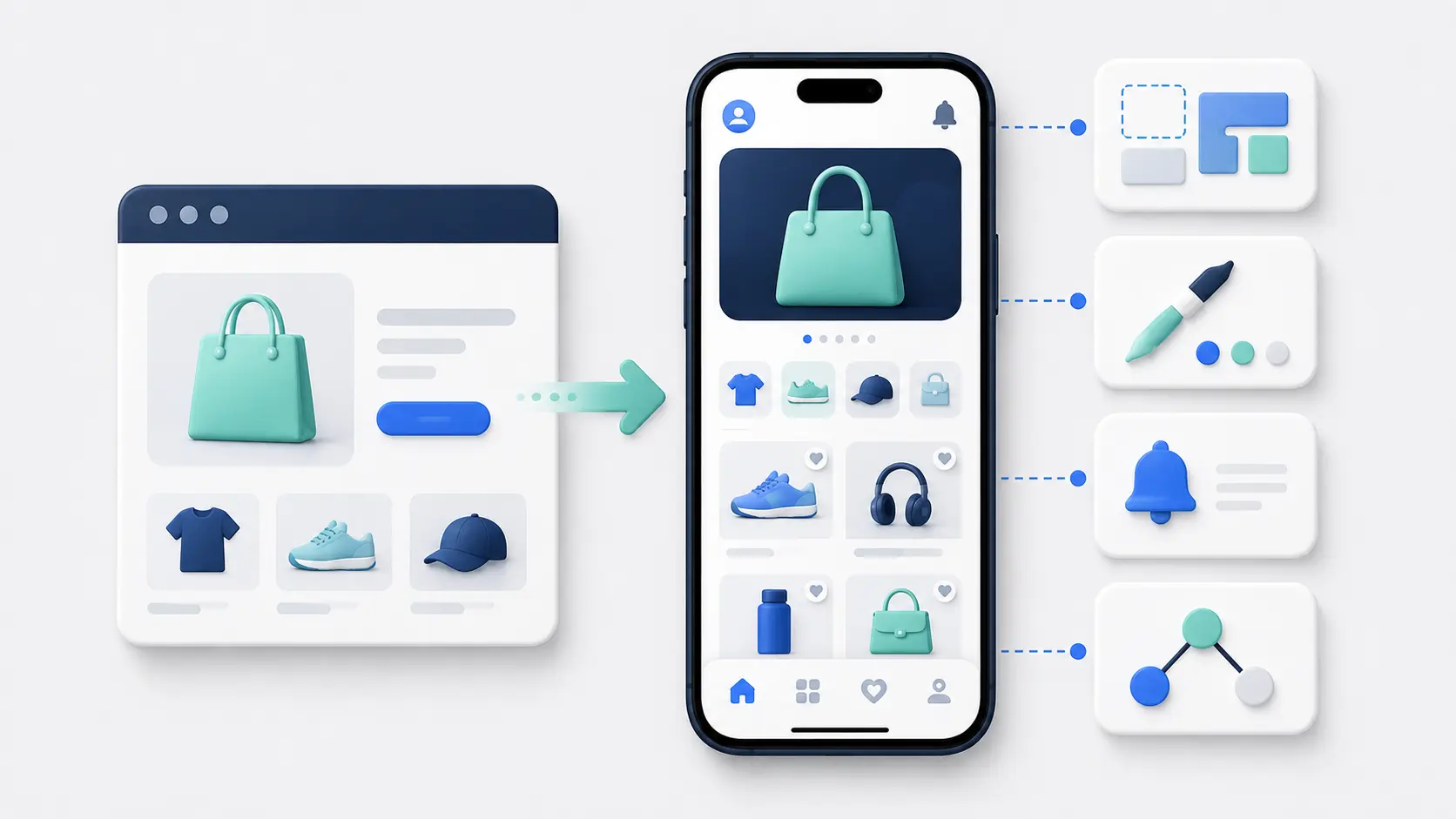
Shopify mobile app builders give you a faster route. They connect to your store, turn your products and collections into an iOS and Android app, and add mobile features such as push notifications.
Some give you a visual, drag-and-drop editor. Others offer more design, development and ongoing support. The right choice depends on your store, your budget and how much work you want your team to take on after launch.
This guide compares nine of the best Shopify mobile app builders available in 2026. We’ll break down how each one works, what it costs, how far you can customize it and where it fits best.
The short answer
There’s no single best Shopify mobile app builder for every store. The best option for you depends on what you want your app to do and how you want to build and manage it.
Here’s a quick summary of the main options:
| Builder | Best for | Operating model | Starting price |
|---|---|---|---|
| Tapcart | Shopify teams that want a mature visual builder with broad integration support | Visual builder with service and developer options | $500/month |
| MobiLoud | Established brands that want their existing Shopify website to power the app | Fully managed, website-powered service | $1,499/month plus setup |
| Shopney | Shopify brands looking for a lower-cost no-code builder | Self-serve visual builder with onboarding support | $149/month |
| Appmaker | Brands that need custom blocks, APIs or developer access | Visual builder with an open developer model | $999/month plus 1% of app sales |
| Appbrew | Teams interested in AI-assisted app content and campaign management | Visual builder with AI tools and service support | $499/month plus a performance fee |
| Superfans | Brands focused on app-only access, loyalty and engagement | No-code builder with design and account support | $150/month on Shopify |
| Plobal Apps | Brands looking for a low-upfront-cost entry route | Drag-and-drop builder with service support | Free to install plus 3% of app sales |
| Venn Apps | Larger brands that want premium design and implementation support | Design-supported, managed app platform | $1,999/month |
| OneMobile | Smaller merchants that want to test an app at a low fixed cost | Self-serve builder with AI and service options | Free plan; paid plans from $99/month |
Shopify app builders don’t all work the same way
Most Shopify app builders use Shopify’s APIs to pull products, collections, customer accounts and orders into a new app interface.
Shopify still powers your catalog, inventory and orders. You then use the app builder’s editor to create a separate mobile storefront, arrange content and run app-specific campaigns.
This gives you control over a distinct app experience. The trade-off is that you’re now managing two storefronts. A new landing page, theme change or custom feature on your website won’t necessarily appear in your app unless you recreate or integrate it.
MobiLoud takes a different approach. It uses your existing website as the foundation of the app, then adds native navigation, push notifications and app-only elements around it. Changes to your site carry over without rebuilding the same experience in another editor.
The amount of support varies too. Some platforms mainly give you the software. Others help with design, implementation, app-store submission and ongoing optimization. That difference matters if nobody on your team has the time to run a second storefront.
Tapcart: A visual app builder for Shopify
Tapcart is a Shopify-only mobile app platform built around App Studio, its visual editing environment.
You can arrange pages and content blocks, control your navigation and publish app content without touching the underlying native code. Your products, customers and orders stay connected to Shopify, while you manage the app’s presentation separately inside Tapcart.
Tapcart has one of the broader integration ecosystems in this market. Its public directory includes tools such as Klaviyo, Recharge, Rebuy, Nosto, Gorgias and Yotpo. It also supports push notifications, personalization, user segmentation and app analytics.
Higher plans give you more control. Scale adds A/B testing, advanced analytics, segmentation, conditional content, metafield support and scheduled publishing. Enterprise+ adds developer tools, third-party data streaming, sandbox accounts, regional apps and a dedicated account manager.
Pricing starts at $500 per month for Growth. Scale costs $1,250 per month, while Enterprise+ starts at $2,850 per month. Lower effective monthly rates are available with annual billing.
Tapcart is one of the first options to look at if you want a dedicated app storefront with a mature editor, broad integrations and room to add custom functionality. You’ll still need someone on your team to keep the app current alongside your website.
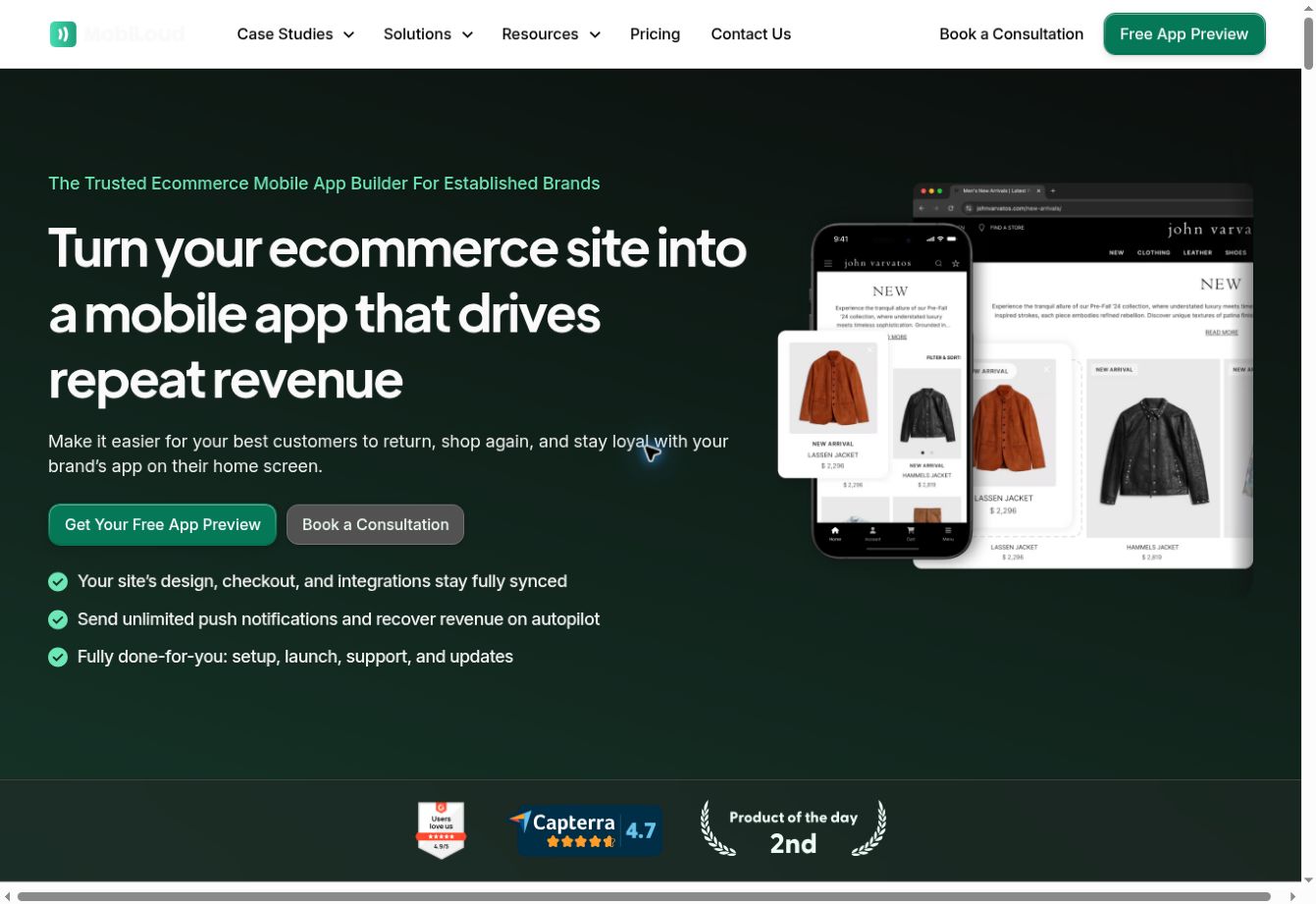
MobiLoud: A managed app powered by your Shopify website
MobiLoud builds iOS and Android apps around the Shopify website you already run.
Your website supplies the shopping experience, while MobiLoud adds the native layer: tab navigation, push notifications and app-specific elements around your existing UX.
You don’t have to rebuild your storefront in a separate visual editor. Your theme, landing pages, custom code and Shopify apps remain part of the app wherever they already work on your mobile site.
This makes MobiLoud a strong fit for customized Shopify and Shopify Plus stores. If you’ve built unique subscription, loyalty, search, personalization or account experiences on the web, you don’t have to find separate app integrations or recreate those flows with pre-built blocks.
MobiLoud is a complete service rather than a self-serve builder. Its team handles design, app configuration, testing, submission to Apple and Google, updates and ongoing native maintenance. The published launch timeline is six to eight weeks.
Pricing starts at $1,499 per month, or $1,274 per month when billed annually, plus a one-time setup fee. The plan includes 10,000 monthly active users, with usage charges above that level.
MobiLoud costs more upfront than most self-serve builders. In return, you keep one storefront and have a partner handling the technical app work, rather than asking your team to build and maintain another version of your store.
Shopney: A lower-cost visual builder for Shopify
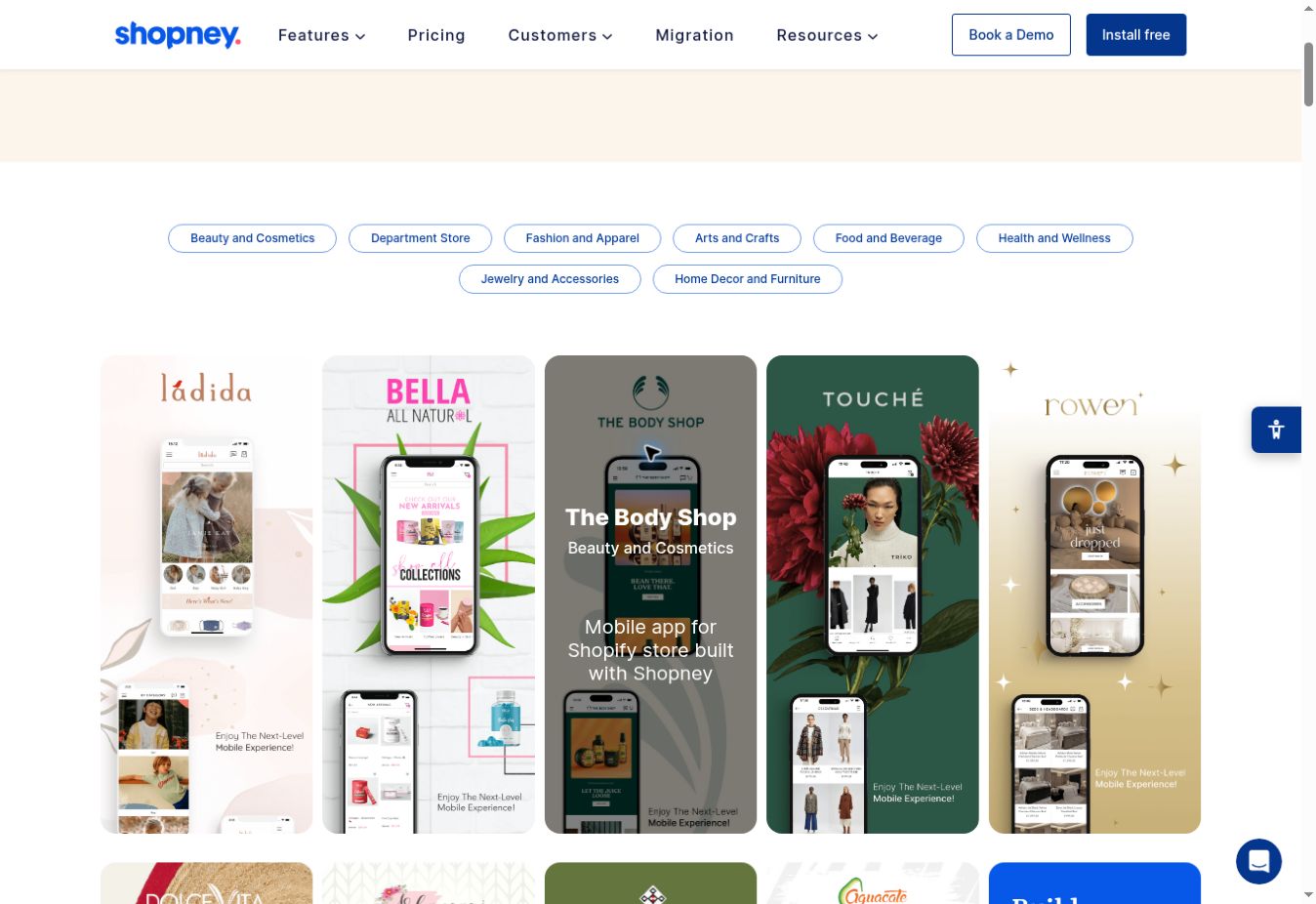
Shopney is a no-code mobile app builder for Shopify and Shopify Plus. It gives you a drag-and-drop editor, several themes and onboarding support across its plans.
Your products, collections, customers and orders stay connected to Shopify. You use Shopney to manage your app layouts and mobile campaigns separately. Public features include unlimited push notifications, in-app chat, app-only discounts, analytics and real-time preview.
The plan structure matters because several common Shopify integrations sit above the entry tier. Silver costs $149 per month and covers the main app foundation. Gold costs $299 per month and adds abandoned-cart notifications, reviews, multi-language and multi-currency support, and search integrations.
Platinum costs $599 per month. It adds segmented and AI-assisted push notifications, loyalty and subscription integrations, plus Klaviyo, Rebuy and Nosto. Enterprise starts at $1,299 per month with multi-store support, attribution integrations, professional design support and a dedicated success manager.
Shopney doesn’t take a commission on sales. It also offers a 30-day free trial, giving you time to test the editor and preview the app before you commit.
Shopney is a good place to start if you want a dedicated Shopify app builder at a lower monthly price. Compare it using the tier that supports your actual stack. If you need Recharge, Klaviyo and advanced segmentation, you’re evaluating the $599 plan, not the $149 plan.
Appmaker: A Shopify builder with developer access
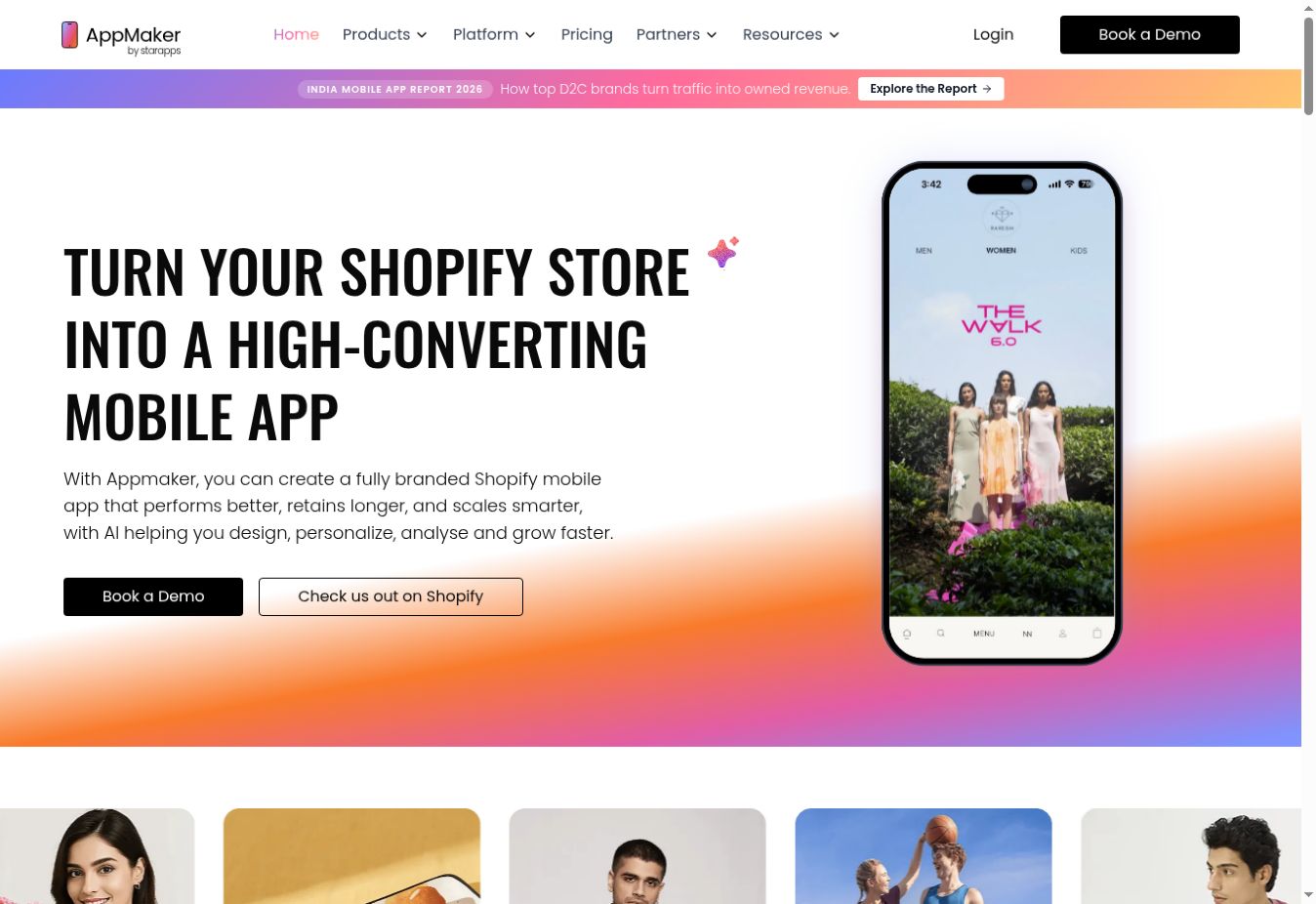
Appmaker combines a visual Shopify app builder with a more open development model.
Appmaker Studio gives you a drag-and-drop content management system for the app. Products, orders and customers sync with Shopify, while conditional blocks let you change content using customer, product and order tags or metafields.
That logic can be useful if you want to show different content to VIP customers, wholesale buyers or shoppers in different markets. Appmaker also documents custom product templates, extensions, custom APIs and deeper developer access.
The Growth plan costs $999 per month plus 1% of in-app sales. Enterprise starts at $2,000 per month plus the same 1% charge. Full developer access, custom themes, custom APIs and deep integrations sit on Enterprise.
Appmaker also charges solutioning and one-time development fees separately. Your total cost can include the subscription, revenue share and any custom implementation work.
The revenue share becomes important as your app grows. At $200,000 in monthly app sales, 1% adds $2,000 per month before custom work. Appmaker makes the most sense when you need its more open customization path and the extra flexibility justifies that pricing model.
Appbrew: AI-assisted app content and campaign management
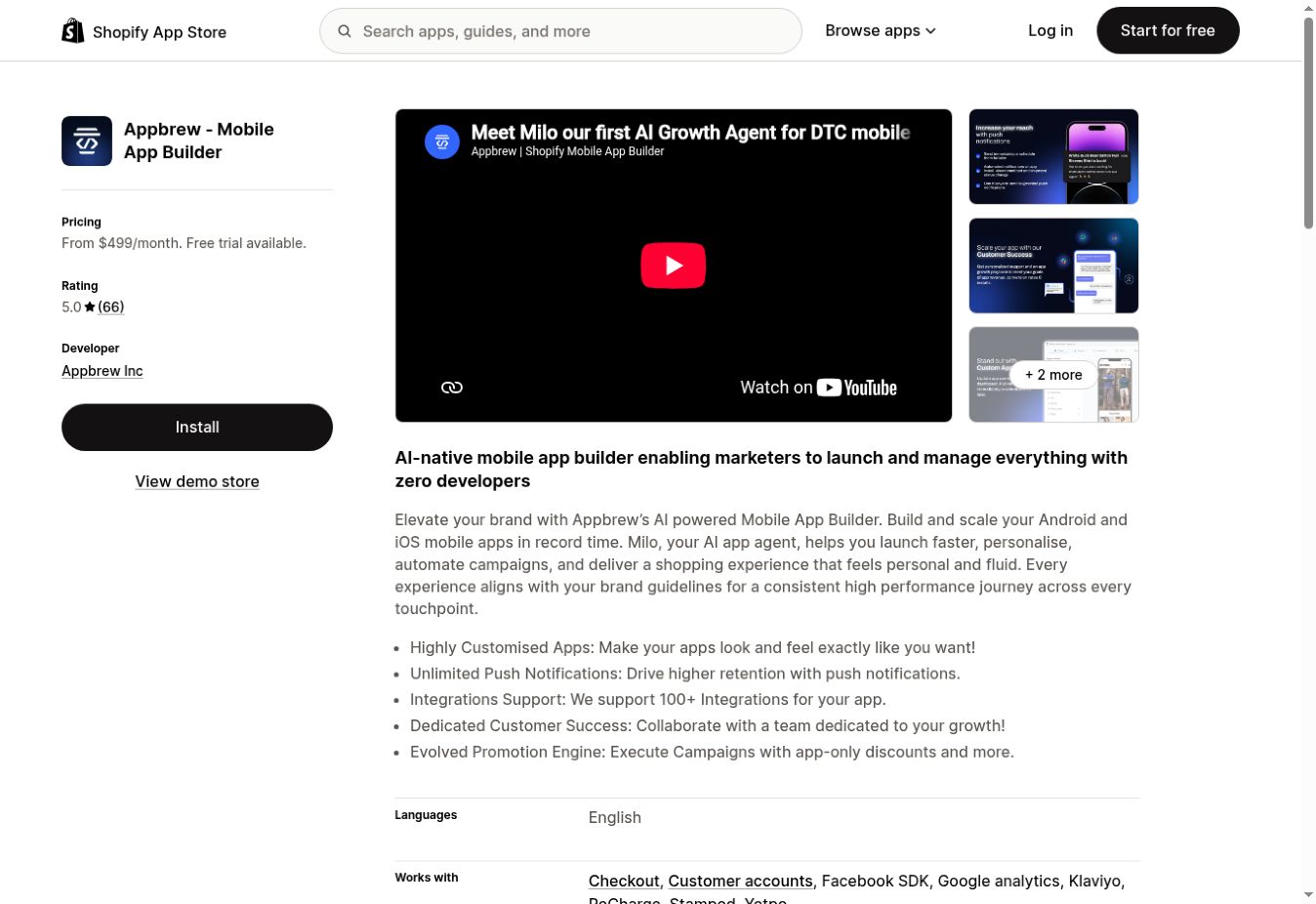
Appbrew is a Shopify mobile app platform that builds AI assistance into the day-to-day management of your app.
Its visual platform creates native iOS and Android apps connected to Shopify. Features include a content management system, analytics, app-only offers, push notifications, video shopping and integrations with tools such as Klaviyo, Recharge, Stamped and Yotpo.
Milo, Appbrew’s AI assistant, helps with user segmentation, content and campaigns. The Pro plan also includes AI content generation inside the CMS. These tools can speed up routine app work, but someone on your team still needs to own the channel and approve what goes live.
The Pro plan starts at $499 per month. Appbrew adds a charge based on app performance, but doesn’t publish the calculation on its Shopify listing. Get the exact formula and model it against your expected app revenue before comparing the price with a fixed-fee plan.
Enterprise starts at $999 per month. It adds custom app design, multi-currency and multi-language support, native subscription management, advanced loyalty and CRM connections, premium integrations and a dedicated customer success manager.
Appbrew is worth considering if AI-assisted merchandising and campaign workflows are a priority. The real price is the subscription plus the performance charge, not the $499 starting figure on its own.
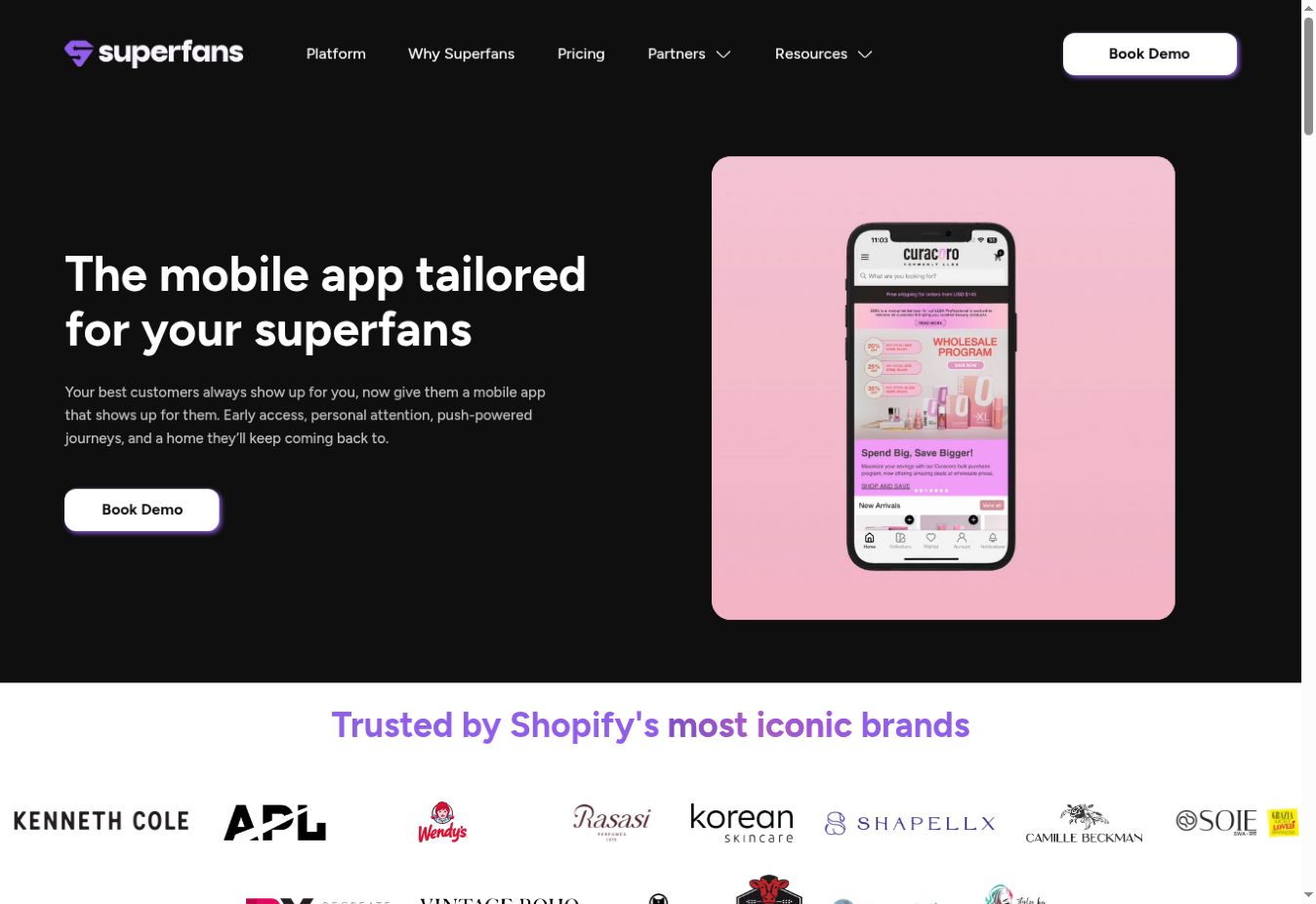
Superfans: App-only experiences and retention features
Superfans is the new name for Vajro, an established Shopify mobile app builder. Its current positioning focuses on loyalty, VIP treatment and repeat engagement.
The platform follows the standard no-code model. Your products and customer data connect to Shopify, while you use a drag-and-drop editor to build and manage a separate app storefront.
Superfans emphasizes reasons for customers to use the app: exclusive discounts, product drops, shipping offers, in-app chat and live selling. It also supports segmented push notifications, abandoned-cart messages and back-in-stock campaigns.
Its Shopify App Store listing shows a $150 per month Starter plan with unlimited push, app-only offers, in-app chat and support. The Superfans pricing page focuses on a $1,000 per month Unlimited plan, which adds unlimited blocks, pages and integrations, a dedicated design manager and a strategic account manager.
Superfans is a good fit when exclusive access, offers and ongoing engagement are central to your app strategy. Check which integrations and design requirements move you from the $150 Starter plan to the $1,000 Unlimited package.
Plobal Apps: A low-upfront-cost route with revenue share
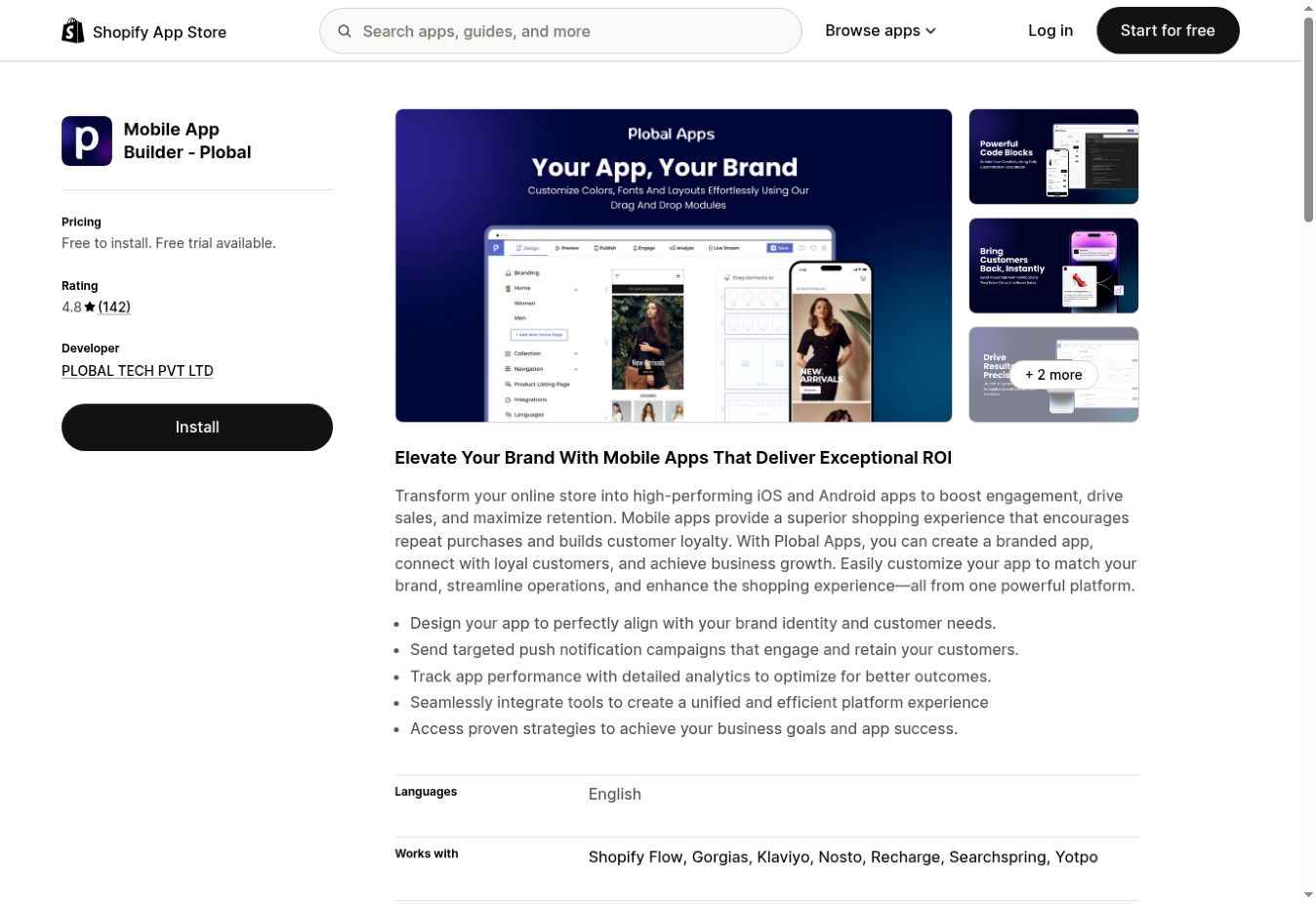
Plobal Apps is a Shopify mobile app builder with a drag-and-drop editor, native iOS and Android apps, push notifications, integrations and real-time analytics.
Its pricing works differently from a simple monthly subscription. The Starter plan is free to install, but Plobal takes 3% of your in-app sales once the app goes live.
Starter includes two standard integrations. Growth costs $199 per month and includes four, while Essential costs $499 per month and includes seven. Essential also adds browse-abandonment campaigns, segmented notifications, product filtering, Apple Pay and a dedicated success manager.
Enterprise costs $1,199 per month plus 1% of in-app sales. It includes unlimited advanced integrations, personalization, multiple page setups, custom fonts and priority support.
The free-to-install plan lowers the initial commitment, but it gets expensive once your app generates meaningful revenue. At $50,000 in monthly app sales, 3% comes to $1,500 for that month.
Plobal gives you several ways to enter at a lower fixed cost. Compare the projected annual total at the app revenue you expect, not just the amount due before launch.
Venn Apps: Premium design and implementation support
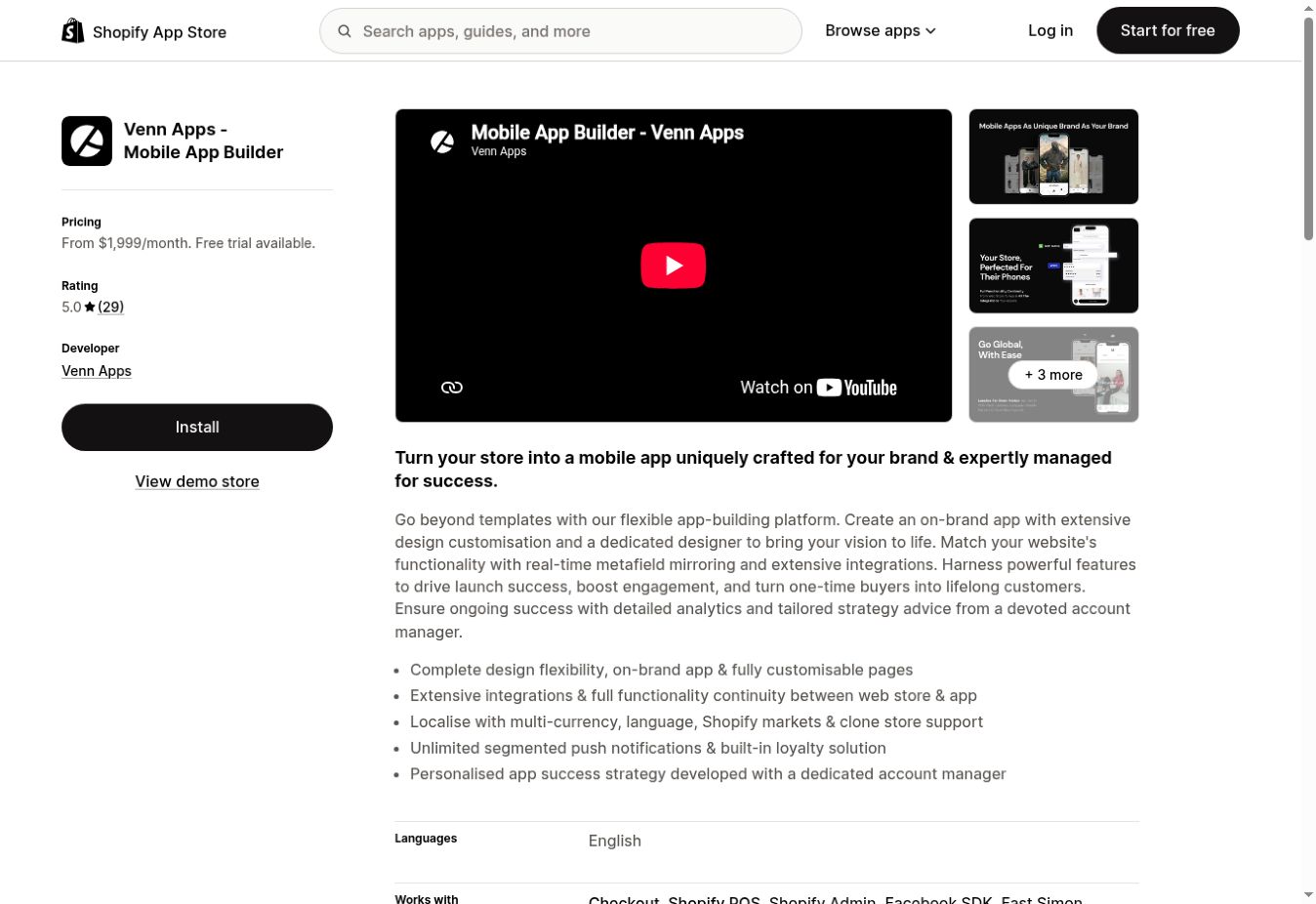
Venn Apps combines a Shopify-connected mobile app platform with dedicated design and account support.
Your app has its own visual layer, but Venn works with you to match your website and brand. Its public feature set includes real-time metafield mirroring, integrations, push notifications, analytics and app-exclusive products and drops.
The Pro plan includes a dedicated designer, advanced design modules, unlimited standard integrations and an editor for your homepage, shop menu and custom pages. You also get unlimited push notifications.
Pro pricing starts at $1,999 per month. Enterprise starts at $2,999 per month and adds custom design modules, premium integrations, in-app loyalty, gifts with purchase, multi-language support, expansion-store support and strategic account management.
Venn sits at the premium, supported end of the Shopify app-builder market. It’s a good option for larger brands that want a separate native app storefront but don’t want to handle the design and implementation alone.
OneMobile: A low-cost entry with revenue-linked fees
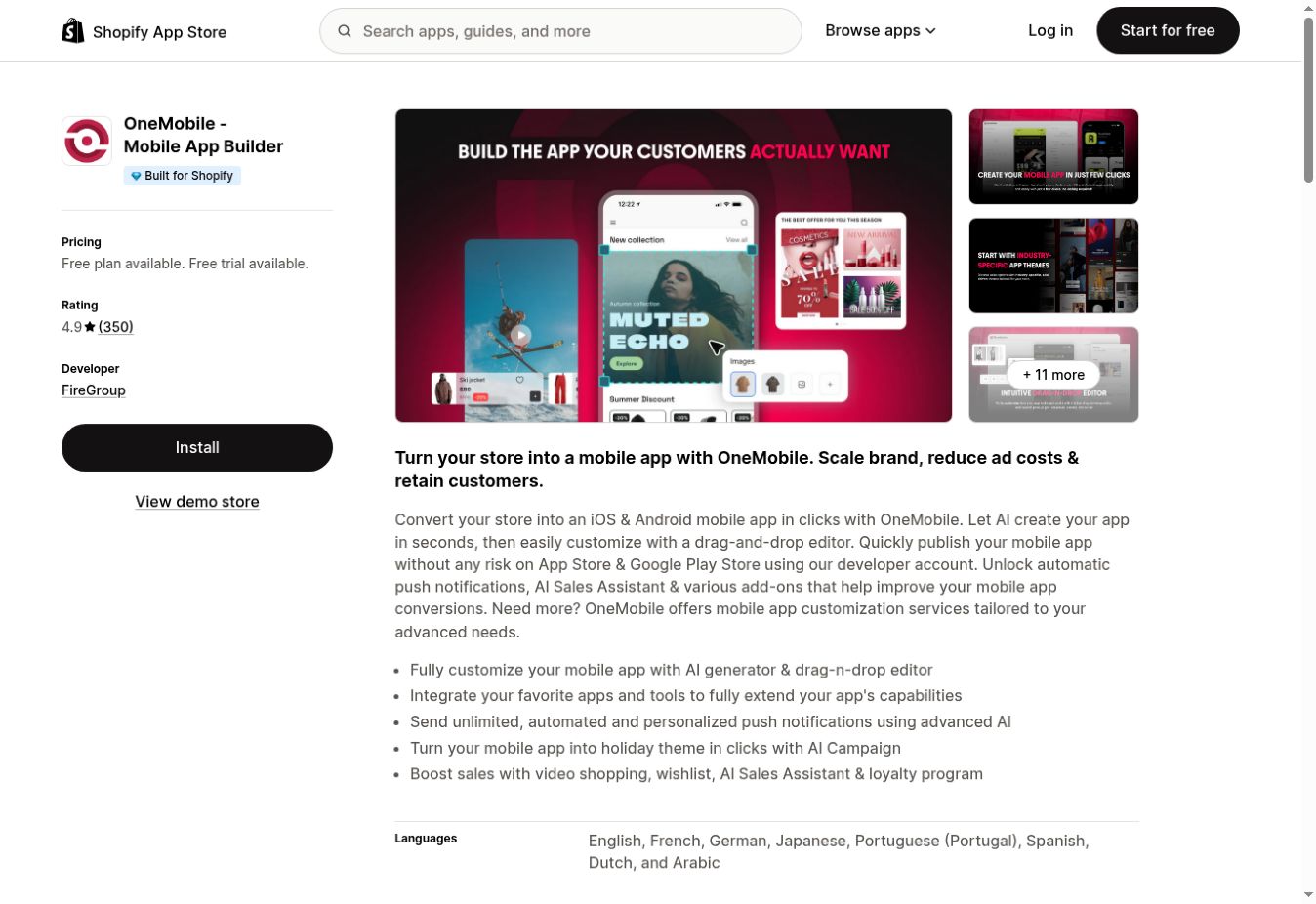
OneMobile offers a no-code Shopify app builder with a free plan, paid tiers from $99 per month and AI-assisted design and marketing tools.
The builder includes themes, design blocks, app preview and Shopify data sync. Paid plans add automated push notifications, more design options, multi-language and multi-currency support, AI campaign tools, shoppable video, advanced search and more service support.
Scale Up costs $99 per month and includes the first $2,000 of monthly mobile revenue, followed by a 2.9% infrastructure fee on revenue above that amount. Brand Up costs $299 per month, includes the first $10,000 and charges 1.9% above it.
Omni costs $990 per month, includes the first $100,000 and charges 1.2% above that level. It also adds tailored features, in-house system integrations, extra screens and a dedicated success manager.
OneMobile can also publish through its developer account. That can simplify the initial launch, but you’ll want to understand who owns the app listing and what happens if you move to another provider later.
OneMobile is a practical option for a smaller Shopify merchant that wants to test an app with a low fixed commitment. Model the infrastructure fees before choosing a plan, especially if you expect app revenue to grow quickly.
How to choose the right Shopify mobile app builder
The right shortlist becomes much clearer once you answer five practical questions.
Do you want one storefront or two?
Most Shopify app builders give you templates and content blocks for a separate app storefront. This gives you control over an app-specific design, navigation and merchandising plan.
The trade-off is duplicated work. Theme changes, campaign pages and custom experiences on your website won’t automatically become matching app screens.
A website-powered app keeps your existing storefront at the center. You preserve more of your current experience and don’t have to manage a second version, but you get less separation between your web and app designs.
Start by deciding whether you want an independent app experience or your current Shopify store delivered as an app with native features around it.
Does it support the customized parts of your store?
Standard products, collections, customers and orders are the easy part. Your decision will usually come down to everything you’ve added around them.
Write down the flows you can’t afford to lose: subscriptions, loyalty, bundles, reviews, search, personalization, product options, wishlists, returns, customer accounts and checkout customizations.
Don’t rely on an integration logo. Ask the provider to show you the exact workflow. A subscription integration might support new purchases but send account changes to a web page. A loyalty integration might show points without reproducing every redemption option.
Who will run the app?
Launching your app is only the start. Someone needs to update content, schedule campaigns, send push notifications, test releases and monitor performance.
A visual builder gives you more direct control, but it also creates a new operating responsibility. A managed service costs more, but can remove much of the design, build and maintenance work from your team.
Put a name against the ongoing work before you sign a contract. If the answer is “the ecommerce team” rather than a specific person with available time, your app is likely to fall behind your website.
How much customization do you need?
“Customizable” can mean changing colors and rearranging blocks. It can also mean building a new component, connecting a private API or adding a native SDK.
Define the requirement first. Then ask which plan supports it, who builds it and who maintains it. Appmaker and Tapcart offer developer paths, while Venn and MobiLoud provide more implementation support.
Get custom work, one-time fees and maintenance responsibilities in writing. A feature built for launch still needs to work when Shopify, the builder or a connected service changes.
What will the app cost in its first year?
The advertised monthly fee isn’t enough. Include setup, higher integration tiers, revenue share, performance charges, usage overages, custom development and your team’s time.
For example, OneMobile’s $99 plan charges 2.9% on monthly mobile revenue above $2,000. At $50,000 in monthly app revenue, that adds $1,392 before the subscription. Plobal Starter would charge 3% of the full $50,000, or $1,500.
You may also need developer accounts. The Apple Developer Program costs $99 per year, while Google Play charges a $25 one-time registration fee.
Model the cost at conservative, expected and strong app-revenue levels. This quickly exposes plans that look inexpensive at launch but become much more expensive if the app performs well.
Which Shopify app builder should you choose?
Start with Tapcart if you want a mature visual builder, broad Shopify integrations and a path to more advanced app-specific features.
Look at MobiLoud if you want your existing Shopify website, custom features and apps to carry into a managed mobile app without rebuilding the storefront.
Shopney gives you a lower-priced visual builder, while Appmaker offers more developer access. Appbrew is built around AI-assisted app operations, and Superfans focuses on app-only access, offers and repeat engagement.
Plobal and OneMobile lower the fixed cost of getting started, but both link part of their pricing to app revenue. Venn sits at the other end of the market, combining a separate app storefront with dedicated design and implementation support.
The right choice isn’t the platform with the longest feature list. It’s the one that supports the store you already run, at a total cost you can justify, with a management model your team can sustain.
Frequently asked questions
Can Shopify create a mobile app by itself?
Shopify doesn’t provide a built-in tool for turning your store into its own branded iOS and Android app.
Shopify does operate Shop, a shared shopping and delivery-tracking app where eligible merchants can run a Shop Store. That isn’t the same as publishing a standalone app under your own brand.
How much does a Shopify mobile app builder cost?
The products in this guide range from free-to-install plans to platforms starting near $2,000 per month. A dedicated builder often starts around $149 to $500 per month, while more supported or customizable platforms can cost $1,000 per month or more.
Add revenue share, performance fees, integration tiers, setup, custom work, usage and the time your team needs to run the app. The advertised starting price rarely tells you the full cost.
Will my Shopify apps work inside the mobile app?
Not automatically. Product and order data normally sync with Shopify, but every third-party app controls a different customer flow.
API-based builders need a supported integration or custom implementation. Website-powered apps can retain more web functionality because they continue to use your existing storefront. In either case, test the exact subscription, loyalty, reviews, search and checkout flows that matter to your store.
How long does it take to launch a Shopify mobile app?
You can assemble a simple template-based app quickly, but a production launch also includes design, integration checks, testing, developer accounts and app-store review.
Allow several weeks for a serious launch. MobiLoud publishes a six-to-eight-week timeline, while Superfans says brands can launch within a week. Your actual schedule will depend on the design, integrations, custom work and how quickly your team supplies assets and approvals.
Can I switch Shopify mobile app builders later?
Yes, but you’ll usually need to rebuild the app on the new platform and submit an updated version to Apple and Google. Your store data remains in Shopify, but layouts, custom components, analytics and push-notification setup may need to be recreated.
Make sure your company knows who controls the developer accounts, app listings, bundle identifiers, signing keys, reviews and push subscriber data before the first launch.
Do I need separate Apple and Google developer accounts?
Most providers expect you to have organization accounts with Apple and Google, and this is usually the cleanest ownership structure. Some builders can publish through their own accounts.
Ask whose name will appear on the listing and what can be transferred if your contract ends. Apple charges $99 per year for its developer program, while Google Play charges a one-time $25 registration fee.