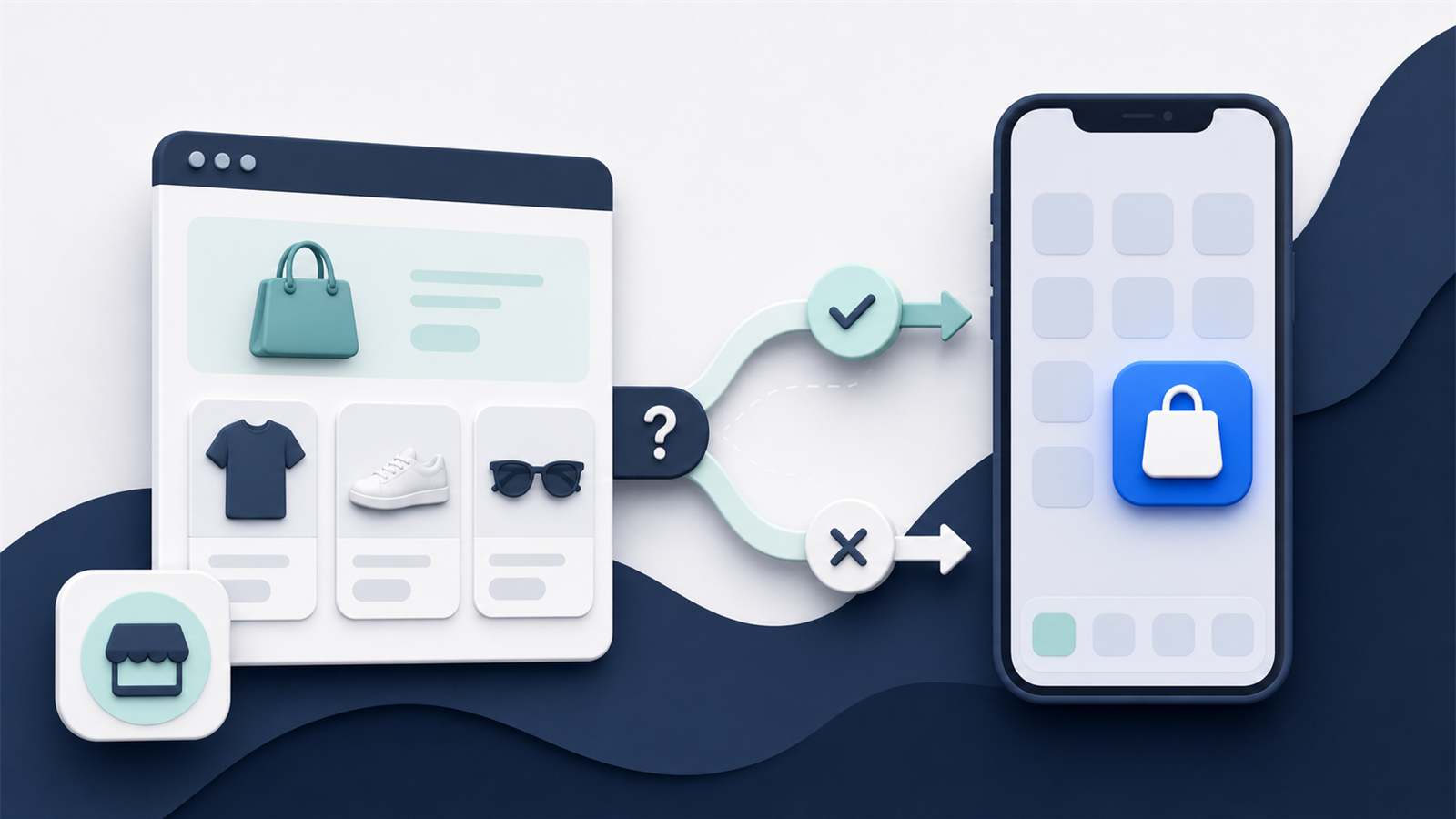
A mobile app can be a powerful channel for an ecommerce brand.
But not every ecommerce brand should build a mobile app. In some cases, launching an app isn’t the right move (or isn’t the right move yet).
An app is an ask. It’s another thing for your customers to download. It’s also another thing for your team to worry about.
For brands operating a certain way, or at a certain stage, adding this to the mix is not ideal.
Keep reading and we’ll explain how to know whether your brand should hold off on the decision to launch an app for now.
You Have Few Repeat Customers
Retail apps are usually strongest for customers who already know the brand and have a reason to return.
If most customers buy once and rarely need the product again, the addressable app audience may be small. A high-ticket product with a multi-year replacement cycle needs another lasting use case, such as service, content, membership, or product management.
Look at repeat purchase rate, purchase frequency, customer lifetime, and the size of your active customer base. Don’t model adoption from total website traffic when most visitors are anonymous or one-time shoppers. Even with a repeat audience, customers still need a reason to move from the website to an app.
Customers Have No Reason to Install
A mobile app can’t rely on “shop our products” as its only value when customers can already do that through your website.
Useful reasons may include easier repeat ordering, valuable loyalty functions, early access, subscriptions, personalized inventory alerts, store tools, or services tied to the product.
If the strongest launch idea is a one-time discount, the brand may buy downloads without creating retained users. Test the proposition with customers before investing in the channel. If the core mobile experience is weak, fix that before adding another surface.
Your Mobile Website Has Basic Problems
An app won’t fix poor product data, confusing navigation, weak search, unreliable inventory, slow operations, bad checkout logic, or a lack of customer demand.
It may hide some interface problems for a small audience while leaving the underlying commerce issues in place. The app can also inherit those problems through its integrations.
Fix the mobile website and core store first. Your website remains the broadest acquisition and shopping channel even after an app launches. The app should preserve that working experience, not replace it with a reduced version.
The App Would Be Worse Than Your Website
Delay the project if the proposed app can’t preserve the journeys your customers rely on.
That may include subscriptions, bundles, loyalty, custom products, promotions, payment methods, markets, pickup, customer accounts, or a highly customized checkout.
The app doesn’t need a native version of every page. It does need to be at least as capable as your website for the customers it serves.
If the platform or budget forces you to remove important functions, choose a different approach or wait. A parity-capable app still needs enough likely users to justify building and operating it.
You Can’t Reach Enough Likely Users
Apps don’t distribute themselves.
A brand with a large recent-customer base, strong email and SMS lists, store traffic, active loyalty members, and regular website visits has several ways to earn adoption. A new store relying almost entirely on paid acquisition has fewer efficient routes.
Build a bottom-up adoption forecast. Count the relevant customers you can reach, the placements you will use, and the reason each group would respond.
If the forecast depends on app-store discovery, it’s probably too optimistic for a branded retail app. Reaching customers also creates ongoing work, which needs a clear owner.
The Economics Need Optimistic Assumptions
Be cautious when the business case only works if adoption, retention, conversion, order value, and purchase frequency all land near the top of their ranges.
Use conservative, expected, and strong scenarios. Include the full cost of setup, software, integrations, internal labor, promotion, maintenance, and eventual switching.
Calculate incremental contribution rather than treating every app order as new revenue.
If the conservative case creates unacceptable losses and the expected case has little evidence behind it, reduce the scope, choose a lower-cost approach, or wait for a stronger customer base. Waiting may also make sense when the underlying store and technology are about to change.
Your Business Is Changing Too Quickly
A major replatform, redesign, market expansion, loyalty migration, checkout change, or identity project can make app requirements unstable.
Launching in the middle of those changes may create duplicate implementation work and testing. It can also produce an app based on systems the brand is about to replace.
The projects can sometimes run together, especially when the app is part of the target architecture. Make the dependencies explicit and avoid committing to a design before the underlying customer journeys are settled.
You Can’t Support Quality and Compliance
An app needs testing across devices, operating system versions, permissions, authentication states, integrations, and checkout paths.
It also needs privacy disclosures, secure data handling, accessible interactions, accurate store metadata, and ongoing compliance with Apple and Google policies.
If the plan has no time or owner for QA, security, privacy, accessibility, or release management, it isn’t ready.
A Different Investment Would Help More
Compare the app with the next-best use of your budget (and focus).
Improving mobile checkout, search, site speed, product content, loyalty, retention email, customer service, or analytics may help a much larger customer group.
The app becomes easier to justify after those foundations are strong. It can then extend a working customer experience rather than compensate for a weak one.
A Quick Decision Test
Delay the app if several of these statements are true:
- Repeat customers are a small part of the business.
- The team can’t describe an ongoing reason to install.
- Critical website journeys won’t work in the proposed app.
- There’s no credible adoption channel or forecast.
- The ROI case depends on aggressive assumptions.
One issue may have a straightforward fix. A pattern across several areas suggests the brand should focus elsewhere first.
The Bottom Line
An ecommerce brand shouldn’t build an app until it has a valuable audience, a durable reason to install, a parity-capable technical approach, an adoption plan, and someone to operate the channel.
Waiting can be the better decision. Improve the foundations, define the use case, and return to the app when the customer and commercial case are strong enough.