Custom development gives you the freedom to build an ecommerce app around your exact requirements.
It also means taking responsibility for a separate software product.
You aren’t only designing a storefront and connecting it to your ecommerce platform. You’re creating app clients for iOS and Android, rebuilding customer journeys, integrating the rest of your stack, managing releases, and maintaining the product as your store and the mobile platforms change.
That can be worth it when the app needs to do something existing platforms can’t support. It is usually unnecessary when the goal is simply to give customers a strong mobile version of the shopping experience you already have.
This guide explains what a custom ecommerce app involves, when it makes sense, and what the project looks like from planning through long-term maintenance.
What Is Custom Ecommerce App Development?
Custom ecommerce app development means designing and engineering an app specifically for your business instead of configuring it on an existing ecommerce app builder.
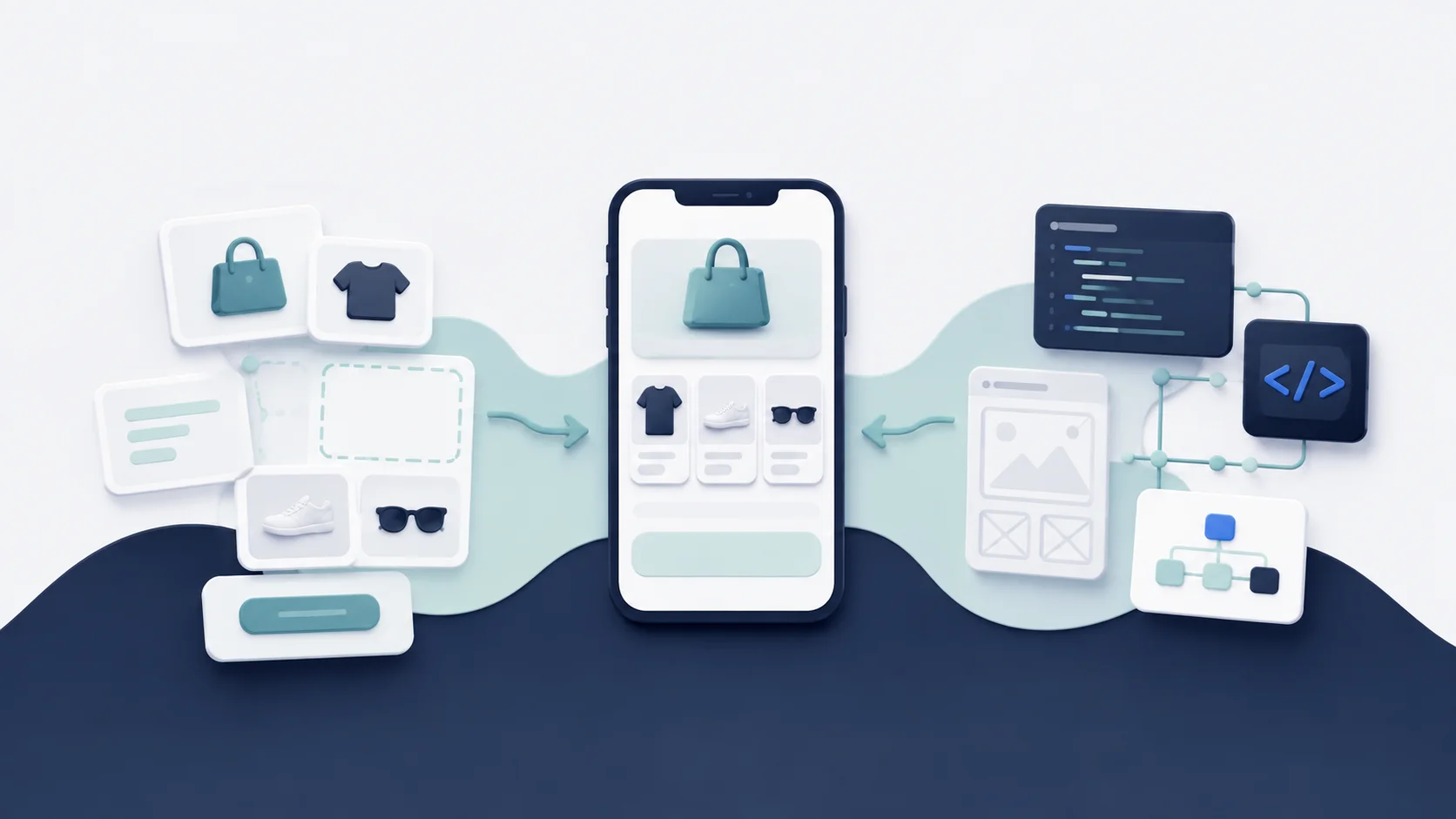
The app usually connects to your commerce platform through APIs. It retrieves products, collections, prices, inventory, and customer data; manages cart and account state; and sends customers into the appropriate checkout. It may also connect separately to search, reviews, loyalty, subscriptions, support, analytics, attribution, and messaging tools.
Custom doesn’t necessarily mean writing two completely independent apps. Your team could build separate native iOS and Android clients, use a cross-platform framework such as React Native or Flutter, or combine app-specific screens with selected web content.
What makes the project custom is that your team owns the product architecture and implementation. You aren’t limited to the layouts, components, release cycle, or integration catalog of an app-builder platform.
When Custom Development Makes Sense
The strongest reason to build custom is an important requirement that established platforms genuinely can’t deliver.
That might be a specialized product configurator, an unusual marketplace model, complex offline behavior, real-time interactive functionality, deep integration with proprietary systems, or a mobile product that goes well beyond shopping.
Custom development can also be justified when the app is strategically important enough to warrant its own product and engineering team. If a meaningful share of the business will run through the app, owning every decision may create long-term value.
The case is much weaker when the proposed custom features are mostly cosmetic. A unique homepage, custom navigation, loyalty, subscriptions, product recommendations, push notifications, and branded content are supported by many app platforms. You don’t need to own an entire mobile stack just to make the app look like your brand.
Before commissioning a custom build, write down the requirements that eliminate existing, more efficient options. If that list is vague, the business case probably isn’t ready.
When It Is More Software Than You Need
Many ecommerce brands already operate a sophisticated digital storefront. Their website contains the design system, merchandising, promotions, product logic, checkout, accounts, and a web of third-party tools.
A custom app doesn’t automatically inherit that investment. The development team needs to reproduce each required journey through the APIs, SDKs, and components available to the app.
This creates two customer-facing storefronts. A change that takes one afternoon on the website may require mobile design, development, testing, and an app release before it appears in the app.
If the app’s main job is to make repeat shopping faster and add push notifications, an app builder or website-based app will normally get you there with less cost and less operational weight.
Our app builder versus custom development comparison goes deeper into that decision.
What a Custom Mobile App Has to Include
The visible interface is only one part of the project.
At a minimum, the app needs a reliable way to handle product discovery, product data, variants, pricing, inventory, cart, checkout, customer identity, and orders. It must also reproduce the customer-facing systems that matter to your store, such as search, reviews, loyalty, subscriptions, bundles, wishlists, support, and regional storefront behavior.
Around that commerce layer, you need the mobile product itself: navigation, loading and error states, deep linking, push notifications, analytics, consent, accessibility, security, app-store assets, and release infrastructure.
These parts have to work as one system. A polished product page doesn’t help if the cart loses a discount, customer sessions expire, inventory is stale, or a push notification opens the wrong screen.
The Custom Development Process
Custom projects vary, but the work usually follows the same broad sequence.
1. Define the Business Case and Requirements
Start with why the app should exist and which customer behavior it should change.
Then document the complete store it must support. Include your ecommerce platform, storefront architecture, markets, currencies, languages, checkout, account model, product types, promotions, and third-party services.
Separate launch requirements from ideas that can wait. A large wishlist makes estimates unreliable and pushes the project toward months of work before a customer can use it.
2. Choose the Architecture
The team needs to decide whether to build separate native apps, use a shared cross-platform framework, or adopt a hybrid model.
It must also decide where business logic lives, which APIs the clients can call directly, what requires a middleware or backend-for-frontend layer, how authentication works, and how the app will respond when data or services are unavailable.
This is a product decision as much as a technical one. The architecture affects release speed, hiring, integration effort, and the cost of every future change.
See Native vs Hybrid vs Cross-Platform Ecommerce Apps for the tradeoffs.
3. Design Complete Customer Journeys
Wireframes should cover more than the ideal path from homepage to checkout.
Design for empty search results, unavailable variants, expired discounts, sign-in recovery, slow connections, interrupted payments, out-of-stock cart items, and customers returning through a deep link.
Reuse patterns from your website where they already work. The app should feel at home on a phone, but it shouldn’t force loyal customers to relearn the brand for no reason.
4. Build the Commerce and Integration Layer
The app needs stable contracts with the ecommerce platform and every service it depends on.
The development team will implement API requests, authentication, caching, event handling, retries, and data mapping. Webhooks or other event systems may keep selected data synchronized without constant polling. Native SDKs may be required for analytics, messaging, attribution, payments, or support.
This is often where the project becomes harder than the prototype suggested. A provider saying it has “integrated loyalty” doesn’t confirm that customers can see points, earn rewards, redeem them, and receive the correct discount at checkout.
5. Build and Test the Apps
Development should be tested continuously on real iOS and Android devices, not only in a browser or simulator.
Testing needs to cover commerce accuracy, customer state, integrations, notifications, deep links, analytics, accessibility, different screen sizes, slow connections, and interrupted sessions. It should use real product configurations, promotions, accounts, and payment methods from your store.
Your ecommerce, support, marketing, and operations teams should participate in acceptance testing. They understand the edge cases that affect customers and orders.
6. Prepare and Submit the Releases
The app needs signed builds, privacy disclosures, screenshots, descriptions, content ratings, support information, and store listings. The brand should own the Apple Developer and Google Play Console accounts.
Submission can result in questions or requested changes. Plan time for review rather than treating upload day as the launch date.
7. Launch, Measure, and Maintain
After release, the team needs to monitor crashes, reviews, funnel performance, notification opt-ins, conversion, and revenue quality. It also needs a process for triaging bugs and releasing changes.
The app will require work when iOS, Android, the ecommerce platform, or a connected service changes. Security patches, SDK updates, API versions, certificates, and new device behavior don’t wait for the next redesign.
What Kind of Team Do You Need?
A serious custom app normally needs product ownership, mobile engineering, backend or integration engineering, design, quality assurance, and release management. Analytics, security, and accessibility knowledge may also be required.
An agency can supply much of that team, but your business still needs an internal owner. Someone must make scope decisions, coordinate stakeholders, provide access to systems, approve journeys, and decide what happens after launch.
Ask what the development partner will still own six or twelve months later. The team that builds version one may not automatically include ongoing monitoring, platform upgrades, integration repairs, or campaign support.
What Does Custom Development Cost?
There is no useful universal price for a custom ecommerce app.
Cost depends on the platforms supported, design scope, number of integrations, account and checkout architecture, backend work, regional requirements, testing, and the amount of genuinely new functionality.
The more important budgeting mistake is focusing only on the initial build. Include discovery, design, development, quality assurance, app-store work, infrastructure, monitoring, maintenance, operating-system updates, API upgrades, and future feature development.
Custom development is an ongoing product budget, not a one-time project fee. For a fuller breakdown of the available approaches, see How Much Does an Ecommerce Mobile App Cost?.
How to Choose a Custom Development Partner
Look past a portfolio of attractive screens. The partner needs to understand commerce systems and long-term product ownership.
Ask them to explain how they will handle your most difficult product type, promotion, account journey, and integration. Review the proposed architecture, API assumptions, testing plan, security responsibilities, release process, documentation, source-code ownership, and post-launch support.
You should leave the selection process knowing:
- Exactly what is included in the first release
- Which parts of your current store will be rebuilt or changed
- Who owns the code, infrastructure, developer accounts, and data
- How changes are estimated, tested, and released
- What ongoing maintenance is included
- How you can transition the product to another team later
A good partner should be willing to tell you when a requirement isn’t worth building.
Final Verdict
Custom ecommerce app development makes sense when the app needs capabilities that available platforms can’t provide, and when the business is prepared to operate the result as a long-term software product.
It doesn’t make sense merely because the brand is large or the website is heavily customized. In those cases, the first question should be whether an app builder or website-based approach can preserve the existing experience without forcing you to rebuild it.
Build custom when the requirement demands it. If a simpler approach can deliver the same customer value, take the simpler approach.