An ecommerce mobile app can take a few weeks or more than a year to build.
The biggest variable isn’t the size of your catalog. It’s how much new software you need to design, develop and maintain.
If you use an established app platform and your store fits its standard functionality, you may be ready to submit in two to eight weeks. A managed project with more design and integration work often takes four to twelve weeks. A custom app usually takes several months, and a complex native build can take a year or more.
Those are planning ranges, not guaranteed delivery dates. The condition of your existing store, the integrations you need and the speed of internal decisions can change the schedule substantially.
Ecommerce App Timelines at a Glance
| Build approach | Typical planning range | Why it takes this long |
|---|---|---|
| Self-service app builder | 2-8 weeks | The platform already exists; your team configures, brands and tests it |
| Managed app service | 4-12 weeks | The provider handles more design, setup, QA and submission work |
| Custom cross-platform app | 4-9 months | The team designs and develops a bespoke app with a shared iOS/Android codebase |
| Separate native iOS and Android apps | 6-12+ months | Two platform-specific applications require more engineering and testing |
App-store review happens after the app is built and sits partly outside the development team’s control. Allow time for submission, feedback and possible resubmission rather than treating the first submission date as the launch date.
Why the Build Approach Changes the Timeline
There is a major difference between configuring an existing system and commissioning a new software product.
An ecommerce app builder already has the mobile framework, common commerce features and app-store packaging in place. Your project is largely about configuration, design, integration and testing.
A custom project starts much closer to a blank page. The team needs to define the product, design the interface, build the application, connect the ecommerce stack, test it and create a process for ongoing releases.
Custom development can give you more control. The trade-off is a longer schedule, a higher cost and more uncertainty.
How Long Does a Self-Service App Builder Take?
A straightforward builder project can be ready for submission in two to eight weeks.
The shorter end is realistic when:
That faster timeline assumes the store uses a supported platform and relatively standard theme, with the necessary integrations already available. It also assumes the team is comfortable using the visual editor, has branding and app-store assets ready, and can make decisions quickly.
A significant testing problem can still move the launch date, even when the initial setup is simple.
The platform has already solved much of the technical work. You connect the store, arrange the interface, apply the brand, configure integrations and test the result.
That does not mean the app appears instantly. Your team still needs to make design decisions, test the buying journey, prepare store listings and complete Apple and Google account requirements.
A builder project can also stretch beyond eight weeks when a supposedly standard store relies on unsupported subscriptions, custom product logic or an unusual checkout.
How Long Does a Managed App Service Take?
A managed ecommerce app launch often takes four to twelve weeks.
The underlying technology may be similar to an app builder, but the provider handles more of the project. That can include design, configuration, integration setup, quality assurance, app-store preparation and submission.
The extra service does not necessarily make the project slower. A team that has launched many apps can move faster than an internal team learning the process for the first time.
The timeline tends to grow when the app needs:
Custom screens, several complex integrations, or a bespoke navigation and merchandising setup will add time. So will launching across multiple markets, languages, currencies, or storefronts.
The calendar also grows when approval must pass through several internal teams or the app needs an extensive legal, privacy, security, or accessibility review.
Ask what “launch” means in the proposed schedule. It may mean the first test build, submission to the stores or the date customers can actually download the app.
How Long Does a Custom Cross-Platform App Take?
A custom cross-platform ecommerce app commonly takes four to nine months.
Cross-platform frameworks let developers share much of the code between iOS and Android. This reduces duplication, but it does not remove the work of planning, design, backend integration, testing and release management.
A relatively focused project may fit near the lower end. A complex app with custom accounts, multiple integrations, international storefronts or new backend services can take longer.
The risk is scope expansion. Once a team is designing from scratch, every workflow becomes open to reconsideration. A project that begins as “the website experience in an app” can turn into a broader redesign of search, loyalty, checkout and account management.
That may produce a better product. It also moves the launch date.
How Long Do Separate Native Apps Take?
Building dedicated iOS and Android apps can take six to twelve months or longer for a substantial ecommerce product.
Native development gives the team maximum control over platform-specific experiences. It also creates more work because features must be implemented, tested and maintained across two applications.
The schedule grows further if the project includes:
A new backend or API layer can add months before the customer-facing app is ready. Complex identity systems, custom checkout and payment flows, in-store functionality, or advanced personalization create additional design and engineering work.
Accessibility and security requirements need to be built into the project rather than added at the end. Migrating an existing app introduces another workstream because accounts, data, analytics, push subscribers, listings, and release ownership may all need to move safely.
For most ecommerce brands, this approach only makes sense when the app is important enough—and distinct enough—to justify a long-term software team.
The Stages of an Ecommerce App Project
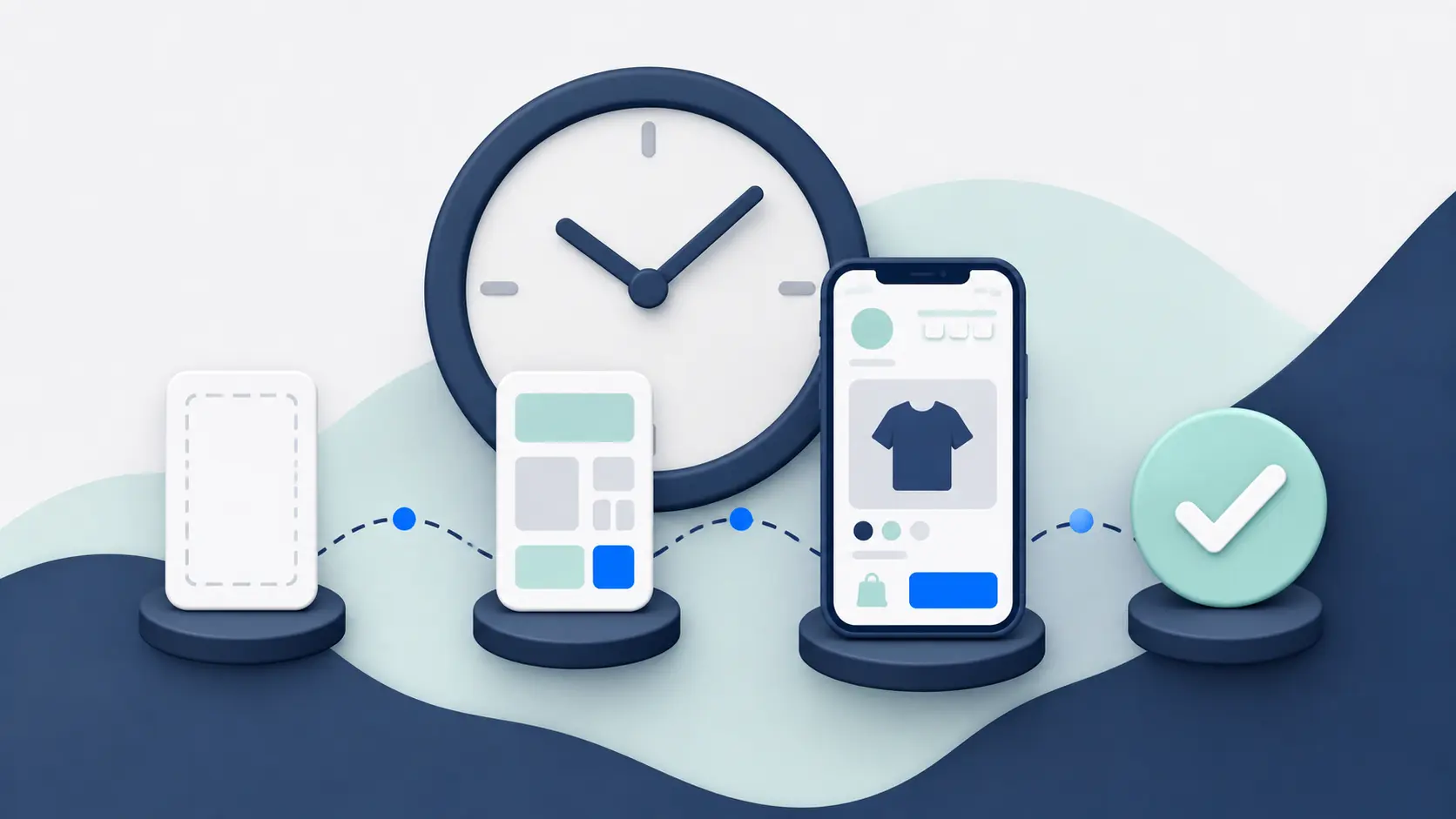
Most projects move through the same broad stages. The amount of work inside each stage depends on the build approach.
1. Planning and Requirements
Typical time: a few days to four weeks
The team defines the audience, commercial goal, launch scope, key customer journeys and success measures.
For a builder project, this may be a focused requirements workshop. For a custom build, discovery can become a substantial project involving user research, technical architecture and a detailed product backlog.
The most useful output is a prioritized requirements list: what is essential at launch, what can follow and what is still an unproven idea.
2. Design and Configuration
Typical time: one to eight weeks
With a builder, the team applies branding and configures existing layouts. With a custom app, designers create navigation, screens, components, interactions and platform-specific states from scratch.
Fast feedback matters here. A design can sit untouched for two weeks while several stakeholders find time to review it.
3. Development and Integration
Typical time: a few days to several months
This stage can be mostly configuration or the largest part of the project.
The app may need to connect products, accounts, carts, checkout, loyalty, subscriptions, reviews, search, analytics and other tools. Standard integrations are quick when the provider already supports them. Custom connections need engineering, documentation and testing.
Confirm support before the project starts. Discovering halfway through that a revenue-critical tool does not work in the app can force a workaround, a scope change or a new provider.
4. Quality Assurance and Acceptance Testing
Typical time: one to four weeks
Testing should cover more than browsing a few products and placing one order.
Use different devices, operating-system versions, customer types, products, discounts, payment methods and markets. Test account recovery, deep links, push notifications, analytics and error states.
The more functionality you introduce late, the more likely this stage is to expand.
5. App-Store Preparation and Review
Typical time: several days to several weeks
You need developer accounts, descriptions, screenshots, icons, privacy information, age ratings and other listing details. The app then goes through Apple and Google’s review processes.
A clean submission may be approved quickly. A rejection or request for clarification adds another cycle. New developer accounts, ownership questions and incomplete privacy disclosures can also create delays.
Do this work in parallel with the build where possible. Do not wait until the app is finished to discover that no one can access the company’s developer account.
6. Launch Preparation
Typical time: one to three weeks, often overlapping other stages
The app needs a distribution plan. Prepare website banners, email and SMS campaigns, social creative, customer-support materials and any download incentive before approval.
This work should not delay the technical submission, but it affects whether launch produces meaningful adoption.
What Usually Delays an Ecommerce App?
Many projects lose more time to uncertainty and coordination than to coding.
The most common causes are:
- Scope changes: New ideas keep entering the launch version after work has started.
- Unproven complexity: Integrations or custom store logic behave differently from the initial assumptions.
- Slow inputs: Decisions, access, assets, or approvals are not available when the team needs them.
- Late testing: Important defects or regional edge cases appear only after the app has been assembled.
- App-store issues: Listings, permissions, privacy details, or functionality need changes before approval.
Integration problems are particularly expensive. An app can look almost finished while a broken subscription or loyalty journey prevents launch.
How to Launch Faster Without Cutting Corners
Speed should come from reducing uncertainty and unnecessary scope—not from skipping important testing.
Define a Focused First Release
Protect the journeys customers already need, then move speculative features into a later phase.
A reliable app with strong shopping, account and retention functionality is more useful than a delayed launch carrying several unfinished experiments.
Test the Hardest Requirements First
Do not begin with colors and homepage blocks. Prove that the app can handle your most complicated product, subscription, checkout, account and multi-market journeys.
If one of them cannot work, you want to know before the project is 80% complete.
Give One Person Ownership
Assign an internal owner who can collect feedback, make routine decisions and keep other teams moving.
This does not mean one person decides everything. It prevents every small question from becoming a meeting with six stakeholders.
Prepare Accounts and Assets Early
Set up or confirm ownership of Apple and Google developer accounts at the beginning. Collect logos, screenshots, descriptions, privacy information and support details while the app is being built.
Test Continuously
Review working builds throughout the project. Continuous testing makes defects easier to isolate and keeps the final acceptance stage from becoming a surprise.
Can You Launch an App in a Week?
Technically, sometimes.
A simple store using a compatible builder may be able to configure and generate an app within days. That is not the same as completing a dependable commercial launch.
You still need to verify integrations, test checkout, prepare store listings, meet privacy requirements and pass app review. If the app will represent an established brand and process real orders, a little more care is worth the time.
Treat “launch in days” as a best-case technical claim, not the schedule you build a campaign around.
What Timeline Should You Plan For?
For a relatively standard store using an app builder, plan for two to eight weeks.
If you want the provider to handle more of the design, setup, QA and submission, or the store has more complex requirements, four to twelve weeks is a more comfortable managed-project range.
For a custom app, plan in months rather than weeks. A shared cross-platform codebase may take four to nine months. Separate native apps can take six to twelve months or longer.
The fastest credible option is usually the one that requires the least new software while still supporting the store properly.
Ask every provider for a stage-by-stage schedule, the assumptions behind it and the responsibilities on both sides. A realistic timeline explains what needs to happen and what could move the date. It does not simply promise a fast launch.